
How Often Should Powerlifters Deload? Signs, Timing, and Adjustments
Your planned squat single was supposed to move at RPE 7, but it felt like RPE 9 for the second week in a row. Back-off sets are slower, your hips stay sore between sessions, and adding more effort has stopped producing better training.
A consistent training record, whether kept in a spreadsheet or a log such as LiftnLog, helps show whether this is one poor session or accumulated fatigue that warrants a deload.
Quick answer: how often should powerlifters deload?
Most powerlifters should plan a deload every four to eight weeks, then move it earlier or later according to performance, fatigue, and the demands of the current block.
- Choose an initial deload interval based on training age, usually after three to seven loading weeks.
- Record normal loads, repetitions, RPE, soreness, and readiness before fatigue becomes excessive.
- Monitor several performance and recovery signals rather than reacting to one bad workout.
- Confirm that the decline persists across two or more sessions or affects multiple lifts.
- Deload for five to ten days by reducing sets about 30% to 50% and load about 5% to 15%.
- Keep practicing the competition lifts, but avoid grinders, failure, and unnecessary accessories.
- Resume training with conservative loads and use the first week back to verify recovery.
A four-week cycle is not automatically better than an eight-week cycle. The schedule should create enough time to accumulate productive training without forcing the lifter to spend several weeks training through obvious fatigue.
Choose a powerlifting deload schedule based on training age
Start with a provisional schedule. It gives the training block structure while leaving room to respond to actual performance.
Beginners often tolerate six to eight loading weeks before needing a dedicated deload. Their absolute loads are lower, they usually perform fewer hard sets, and they can still progress without pushing every top set close to their limit. Some beginners do not need a formal deload at all during the first few months. A lighter week caused by travel, scheduling, or conservative load progression may provide enough recovery.
Intermediate powerlifters commonly deload after four to six loading weeks. At this stage, sessions contain more lift-specific volume, heavier top sets, and enough accessory work to create fatigue that carries into the next week.
Advanced lifters may use three to five loading weeks before reducing stress. Heavy competition lifts impose a substantial recovery cost, and advanced athletes often need more work to produce a smaller adaptation. Their margin between useful overload and excessive fatigue is narrower.
These ranges are starting points, not deadlines. A lifter who sleeps well, maintains performance, and finishes the block near the planned RPE may extend it. A lifter whose technique and estimated strength decline in week three should not wait until week six because that was the original plan.
Consider Maya, a 74 kg raw powerlifter running five loading weeks followed by one planned deload. At the start of the block, she squats 160 kg for a single at RPE 7, then completes four sets of five at 125 kg. Her bench press and deadlift follow a similar top-set and back-off structure. We will use her training record throughout the article.
If you are still learning how weekly progression fits together, begin with a structured 12-week powerlifting program for beginners rather than adding frequent recovery weeks to an inconsistent routine.
Establish a baseline before deciding when to deload
Fatigue signals only become useful when compared with the lifter’s normal performance. Record the first two weeks of a block carefully.
For each competition lift, note the load, repetitions, RPE, number of working sets, and whether technique met the programmed standard. Also record a small number of recovery variables that you can assess consistently, such as sleep duration, joint discomfort, motivation to train, and soreness during the warm-up.
Do not build a complicated readiness score from 12 subjective ratings. It creates work without necessarily improving the decision. Two or three recovery measures, combined with performance data from the barbell, are usually enough.
Maya’s baseline squat single is 160 kg at RPE 7. Her 125 kg back-off sets take roughly the expected effort, and her final set reaches RPE 7.5. She reports mild quadriceps soreness the following day, but it is gone before the next squat session. That is normal training stress.
By week four, 160 kg feels like RPE 8.5 and her final back-off set reaches RPE 9. The number on the bar has not changed. The cost has.
RPE is useful here because it captures changes that load and repetitions alone cannot show. Research on repetitions-in-reserve scales supports their practical use for prescribing resistance training intensity, although lifters become more accurate with experience. The published study is available through the National Library of Medicine.
If RPE ratings are inconsistent, use the examples in this guide to RPE for powerlifting. Lifters who prefer repetitions in reserve can also review how RPE and RIR differ in strength training.
Monitor the signs that a powerlifter needs a deload
No single symptom proves that you need a deload. Look for a pattern involving barbell performance, recovery, and tolerance for normal training.
| Signal | Normal short-term variation | Deload warning | Practical response |
|---|---|---|---|
| Top-set RPE | One set is 0.5 to 1 RPE higher than planned | The same load is 1.5 to 2 RPE higher across two sessions | Reduce that day’s back-off work and review the following session |
| Repetition performance | One missed rep caused by setup or execution | Repeated rep loss at loads completed earlier in the block | Stop progression and schedule lighter work |
| Bar speed and technique | A slow final rep with stable positions | Warm-ups look slow and technical errors appear early | Lower load and avoid additional heavy sets |
| Soreness | Resolves before the muscle is trained again | Persists into the next exposure or changes movement | Remove aggravating accessories and reduce sets |
| Joint discomfort | Mild and stable during warm-ups | Increasing pain or compensation under load | Stop the provoking movement and assess the issue |
| Motivation and readiness | One low-energy day | Several sessions with low readiness plus poorer performance | Deload and address sleep, food, and life stress |
Performance signals deserve more weight than a vague feeling of tiredness. If a lifter feels unmotivated but completes every planned set at the expected RPE, a full deload may not be necessary. A shorter session, fewer accessories, or an extra rest day may solve the problem.
The reverse also applies. Some lifters enjoy training enough to report high motivation while their top sets become progressively slower. The barbell data should not be ignored.
For Maya, the higher squat RPE is joined by two other signals in week five. Her 205 kg deadlift single rises from RPE 7.5 to RPE 9, and persistent adductor soreness changes her squat stance during warm-ups. Bench press remains close to plan. The pattern is broad enough to justify a deload, even though one lift is still performing well.
Pain needs separate treatment. A deload may reduce irritation, but it is not a diagnosis or a substitute for appropriate medical assessment. Sharp pain, worsening symptoms, sudden weakness, or altered sensation should not be managed by simply taking 10% off the bar.
Confirm fatigue before changing the powerlifting program
One poor session can come from missed meals, poor sleep, an unfamiliar rack, or a stressful day. Respond during the session, then wait for more information before rewriting the block.
First, adjust the current workout. If the planned single is RPE 9 instead of RPE 7, reduce the load until the target effort is restored. Cut one or two back-off sets if warm-ups and early work sets remain unusually difficult.
Next, review the preceding seven to fourteen days. Check whether the same lift has declined twice, whether another competition lift is affected, and whether recovery markers have also worsened. Export or inspect the recent training record before relying on memory.
Finally, rule out causes that a deload will not fix. A calorie deficit, illness, major sleep loss, poor load selection, or a technique change can all produce a performance decline. If the program has prescribed RPE 9.5 top sets every week, the programming itself may be the problem.
This is where percentage-based programming can mislead a fatigued lifter. A prescribed 85% remains 85% on paper even when readiness has fallen. Autoregulation allows the working weight to change while the training target stays intact. The powerlifting autoregulation guide explains how to make those adjustments without turning every session into guesswork.
Maya’s week-five review shows that squat and deadlift performance have declined across two exposures. Sleep has remained stable, and she has not changed body weight or equipment. Accumulated training fatigue is the most likely explanation, so the planned week-six deload stays in place. If these signs had appeared in week four, moving the deload forward would have been reasonable.
How to adjust volume and intensity during a powerlifting deload
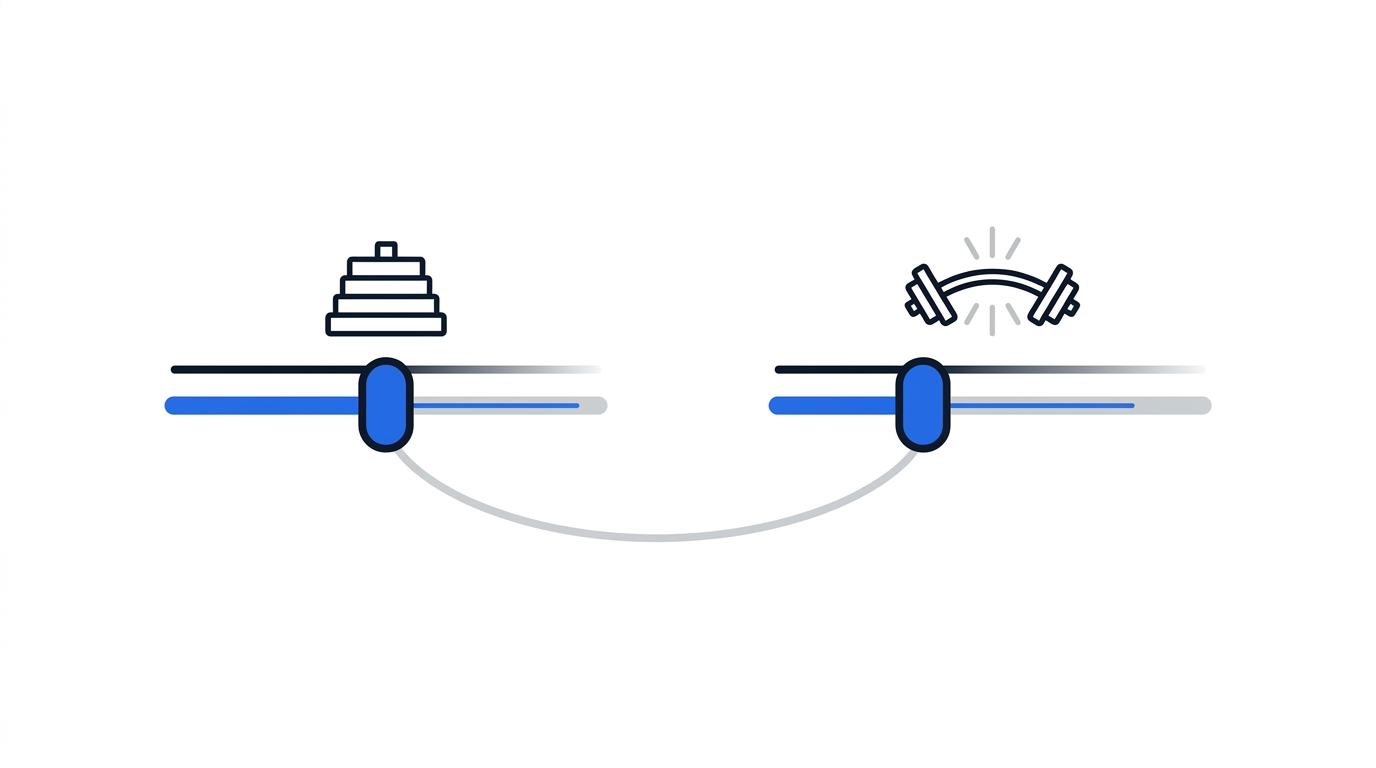
A useful deload preserves the movement pattern while lowering the amount of fatigue created. For most powerlifters, that means reducing volume more aggressively than intensity.
Cut total working sets by roughly 30% to 50%. A lifter completing five squat work sets might perform two or three. Accessories can be reduced to one or two easy sets, replaced with less demanding variations, or removed for the week.
Reduce load by approximately 5% to 15%. Keep working sets around RPE 5 to 7, with no missed repetitions and no slow grinders. The exact reduction depends on how fatigued the lifter is and how close the original program was to maximal effort.
Keep the competition squat, bench press, and deadlift in the week unless pain or a technical issue makes one inappropriate. Frequent practice helps retain setup consistency, commands, and confidence. The American College of Sports Medicine’s resistance training progression model also emphasizes matching training volume and intensity to the athlete’s experience and goals rather than treating one prescription as universal.
Maya’s normal squat session contains a top single followed by four sets of five. During the deload, she performs one single at 145 kg, around RPE 5.5, followed by two sets of four at 110 kg. She keeps two light sets of split squats and removes leg press work.
Her bench press has shown little fatigue, but she still reduces it from five working sets to three. Keeping the full bench workload while cutting everything else could leave upper-body fatigue unresolved. Her deadlift drops from a heavy single plus three back-off sets to three sets of three at an easy load.
A powerlifter with severe fatigue may need a larger reduction or several complete rest days. A lifter taking a scheduled preventive deload while performing well can stay closer to normal loads and simply cut sets.
Do not test a one-rep max to check whether the deload worked. Testing creates more fatigue and provides noisy information at the exact point when recovery is the priority.
Deloads, tapers, and time off are not the same
A deload reduces fatigue during an ordinary training cycle so the next block can be productive. A meet taper reduces fatigue while preserving competition readiness, and it ends on a specific date. Complete time off removes lifting exposure altogether.
During a general deload, moderate technique work and easy accessories are appropriate. A meet taper is more specific. Volume usually falls while lifters retain enough intensity to stay familiar with heavy attempts. Tapering research generally supports substantial volume reduction while maintaining some training intensity, though the best duration varies by sport and athlete. One relevant meta-analysis can be reviewed through the National Library of Medicine.
Do not insert a generic deload immediately before a meet and assume it functions as a peak. Use a planned powerlifting taper before the meet that accounts for final heavy exposures, attempt selection, and the different recovery times of squat, bench press, and deadlift.
Complete rest is useful when a lifter is ill, psychologically exhausted, traveling, or unable to train without aggravating an injury. It also carries a trade-off. Several days away from the lifts can make setups feel unfamiliar, particularly for lifters who rely on frequent bench practice. If normal movement is comfortable, lighter lifting is usually more specific than doing nothing.
How LiftnLog supports deload decisions step by step
A fixed calendar can tell you when a deload was planned. It cannot show whether the lifter arrived there too early, too late, or at the right time. That requires a usable record of planned and completed training.
Inside LiftnLog, start by entering the loading weeks and provisional deload week. This establishes the expected rhythm without making the recovery week immovable.
As each workout is completed, record the actual load, repetitions, sets, and RPE. Enter what happened, not what the program expected to happen. If a 160 kg squat was planned at RPE 7 but felt like RPE 9, the completed record should show RPE 9.
Review recent sessions before progressing the next week. Compare the same lift under similar conditions and look for rising RPE, lost repetitions, reduced back-off volume, or repeated load reductions. Add brief notes when soreness, sleep loss, equipment, or technique affected the result.
When the evidence supports a deload, edit the week’s work in the same order used above: lower the number of working sets first, reduce load enough to keep effort easy, retain competition-lift practice, and remove accessories with poor recovery value.
After the deload, record the first normal session instead of assuming recovery is complete. Maya’s first squat single after the lighter week is 157.5 kg at RPE 6.5. Her adductor soreness has resolved, and her back-off sets return to the intended range. Those results support beginning the next block.
If the single had remained at RPE 9, adding more loading would not be sensible. The next step would be to inspect sleep, nutrition, pain, exercise selection, and the overall program rather than extending the deload indefinitely.
The practical value is continuity. The original plan, the fatigue signals, the deload adjustment, and the return to training remain connected instead of being spread across memory, loose notes, and separate calculators. See the current LiftnLog features for the available training workflow.
How to resume powerlifting after a deload
Return to normal training with a verification week, not a punishment week. There is no need to compensate for reduced deload volume by adding extra sets.
For the first exposure, use the planned load only if warm-ups move normally. Keep the top set about 0.5 to 1 RPE below the hardest work planned later in the block. Resume most back-off work, but leave room to remove a set if fatigue returns quickly.
Maya begins her new block with 157.5 kg rather than forcing an immediate increase above the previous 160 kg baseline. The single moves better, and she completes three back-off sets before returning to four the following week. This gives her evidence that she is ready for more work.
If performance improves for one session and immediately falls again, the previous block may have exceeded recoverable volume. Reduce the next block’s weekly sets, cap top-set RPE, or remove an accessory that duplicates stress already created by the competition lift.
Top sets and back-off work are especially useful here because they separate daily readiness from volume prescription. Read the guide to programming top sets and back-off sets if your current sessions treat every set as equally demanding.
Common powerlifting deload mistakes
The first mistake is waiting for a failed lift. Failure is a late and costly fatigue signal. Rising RPE, repeated load reductions, and deteriorating technique usually appear earlier.
The second is changing every exercise. A week filled with unfamiliar machines and new variations may be lighter, but it also removes practice from the movements that matter. Keep familiar competition patterns unless pain prevents them.
Another mistake is cutting intensity while keeping all the sets and accessories. Very light work can still create fatigue when there is enough of it. Reduce volume clearly.
Some lifters turn the deload into an unplanned test week because the warm-ups feel good. That defeats the purpose. Finish the easy session and carry that readiness into the next block.
The opposite error is scheduling a deload every fourth week regardless of need. This may be appropriate for an advanced lifter with dense training, but it can interrupt progress for a beginner performing manageable work. Use the calendar as a checkpoint, then use the training record to make the decision.
Finally, do not use deloads to conceal a program that repeatedly drives every lift to RPE 9 or 10. If each block ends with pain, failed repetitions, and a two-week recovery period, reduce the ordinary workload. Better programming should make deload timing more predictable.
FAQ about how often powerlifters should deload
Should powerlifters deload every four weeks?
Some should, but many do not need to. A four-week pattern fits advanced lifters, high-volume blocks, and athletes who accumulate fatigue quickly. Beginners and lower-volume lifters may train productively for six to eight weeks before a formal deload. Review performance before making every fourth week lighter by default.
Can I deload for only three or four days?
Yes. A short deload can work when fatigue is mild or scheduling already creates several rest days. Reduce the hardest sessions, retain easy technique work, and assess the next workout. More accumulated fatigue may require a full five to ten days.
Will I lose strength during a deload week?
A normal deload is too short to cause meaningful strength loss for most healthy lifters. You may feel less practiced after complete rest, which is one reason to keep easy competition-lift exposure. Reduced fatigue often makes strength easier to express when regular training resumes.
Should I use RPE or percentages during a deload?
Both can work. Percentages provide a clear starting load, while RPE accounts for current readiness. A practical approach is to prescribe a reduced percentage and cap the effort at RPE 6 or 7. Lower the weight if the percentage exceeds that cap. An RPE calculator for powerlifting can help estimate suitable loads, but the set still needs to be judged in real time.
Do I need a deload if only one lift is getting worse?
Not always. First check technique, exercise order, local soreness, and the amount of work assigned to that lift. You can reduce one lift while maintaining the others. A full deload becomes more compelling when several lifts decline or the single-lift problem appears alongside poor recovery.
Should a powerlifting meet-prep program include deloads?
Yes, but their placement should support the final peak. Earlier recovery weeks can follow the normal training cycle. Near the meet, use a specific taper rather than a generic deload so volume, intensity, and final heavy sessions align with competition day.
What if I still feel fatigued after the deload?
Do not start another hard block automatically. Review whether the deload actually reduced total work, then examine sleep, food intake, illness, life stress, pain, and the preceding block’s workload. Persistent or worsening physical symptoms may require assessment by a qualified healthcare professional.
For lifters who consistently record their work, the choice becomes clearer: use a provisional four-to-eight-week schedule, move the deload when multiple signals justify it, and return only as fast as performance supports. LiftnLog is suited to lifters who want that decision tied to completed sessions rather than memory alone.