
How to Use RPE in Powerlifting: A Practical Guide to Choosing Your Loads
Your program calls for a squat single at RPE 8, but the bar feels heavier than it did last week. You can force the planned weight, lower it, or keep guessing until warm-ups turn into a workout of their own.
RPE gives you a structured way to make that decision. LiftNlog uses this approach in its RPE-based powerlifting programming, where the target describes the intended difficulty rather than forcing the same load under every condition.
How to use RPE in powerlifting: the quick answer
Use this sequence for every RPE-based working set:
- Read the prescribed reps and target RPE before loading the bar.
- Review recent sets of the same lift and rep range.
- Use your warm-ups to estimate how your strength is presenting today.
- Choose a starting weight that should leave the required reps in reserve.
- Perform the set without intentionally exceeding the target.
- Rate the set by asking how many technically acceptable reps remained.
- Adjust the next set up, down, or not at all based on the actual RPE.
- Log the load, reps, and actual RPE so your next estimate uses evidence.
For example, RPE 8 generally means finishing with about two repetitions in reserve. If a 165 kg squat single feels like RPE 9, the next set should usually be reduced instead of treating 165 kg as a fixed requirement.
What RPE means in powerlifting
RPE stands for rating of perceived exertion. In powerlifting, lifters usually use a 1-to-10 scale tied to repetitions in reserve, commonly shortened to RIR.
RPE 10 means no additional repetition was available. RPE 9 means one remained. RPE 8 means approximately two remained. This resistance training-specific version differs from broader exertion scales used in endurance exercise because it asks a concrete question: how many more good reps could you have completed?
Research on the repetitions-in-reserve scale has found that trained lifters can use it to quantify effort, although ratings tend to become more accurate as a set gets closer to failure. The original resistance training-specific RPE research is available through the National Library of Medicine.
| That qualification matters. |
|---|
| A lifter can usually distinguish RPE 9 from RPE 7 more reliably than RPE 6 from RPE 5. |
| Very easy work gives fewer clues because bar speed remains high and fatigue is limited. |
The powerlifting RPE scale and reps in reserve
Use the following table as a practical interpretation rather than a promise that every set will fit perfectly into one category.
| RPE | Approximate reps in reserve | Practical description |
|---|---|---|
| 10 | 0 | Maximum effort. Another technically acceptable rep was not available. |
| 9.5 | 0, but slightly more load may have been possible | No additional rep, although the set was not an absolute load limit. |
| 9 | 1 | One more good rep was available. |
| 8.5 | 1 to 2 | Probably one more rep, with some chance of a second. |
| 8 | 2 | Two more good reps were available. |
| 7.5 | 2 to 3 | At least two remained, and a third was uncertain. |
| 7 | 3 | About three more reps were available. |
| 6 | 4 or more | Fast, low-fatigue work that is difficult to rate precisely. |
The phrase “good rep” is important. A deadlift completed with a major technical breakdown does not prove that another competition-standard repetition was available. Judge RIR against the technique your program is intended to practice.
The LiftNlog RPE chart for powerlifting expands this relationship across different rep counts and estimated percentages of one-rep max.
How RPE and reps in reserve work together
RIR is the estimate you make immediately after a set. RPE is how that estimate is reported on the scale.
Suppose you bench 90 kg for five repetitions. After the fifth rep, you believe you could have completed two more without losing your pause or changing your bar path. Record the set as RPE 8.
If one additional rep was certain but a second was doubtful, RPE 8.5 is reasonable. Do not spend several minutes debating half a point. The rating only needs enough precision to guide the next decision and improve your records over time.
Bar speed can help, but it is not the rating itself. Some lifters grind most heavy deadlifts even when another rep remains. Others move a final bench press quickly before failing the next attempt. Learn the relationship between speed, technique, and remaining capacity for each of your lifts.
Avoid rating discomfort instead of exertion. High-rep squats can feel unpleasant while remaining several reps from failure. A heavy single can feel calm while sitting at RPE 9. Judge remaining performance, not breathing rate or motivation.
How to choose a powerlifting weight from a target RPE
A prescription such as “one repetition at RPE 8” contains two requirements. You must perform one rep, and the load should leave roughly two reps in reserve. It does not prescribe a permanent percentage.
Start with recent training data from the same lift variation. A competition squat single from seven days ago is more useful for today’s competition squat than a set of five high-bar squats from three months ago.
Percentage charts can provide an initial estimate. A typical chart might place a single at RPE 8 near 92 percent of one-rep max, a triple at RPE 8 near 86 percent, and five reps at RPE 8 near 81 percent. These are starting points. Your own history should replace the generic estimate once enough sessions have been logged.
Use a current estimate, not your best-ever max
Consider a worked example involving a lifter with these recent estimated maximums:
- Squat: 180 kg
- Bench press: 115 kg
- Deadlift: 210 kg
These values describe current training performance. The lifter once deadlifted 220 kg in competition, but recent work no longer supports using that number to select ordinary training loads.
Using 220 kg would suggest a heavier starting weight for almost every deadlift prescription. That is exactly what went wrong during an earlier session: a triple intended for RPE 8 was loaded according to the old meet result and finished near RPE 9.5. The remaining sets then had to be cut sharply.
Base the next decision on recent evidence. Personal records still matter, but they do not always describe today’s capacity.
Let warm-ups confirm or reject the estimate
Warm-ups should narrow the load range without creating unnecessary fatigue. Take normal jumps and pay attention to position, speed, pain, and effort.
For a planned squat single at RPE 8, the example lifter might warm up with the empty bar, 60 kg, 100 kg, 130 kg, and 150 kg. If 150 kg moves as expected, 165 kg is a defensible first attempt. It is close to 92 percent of the current 180 kg estimate.
If 150 kg is unusually slow or balance is poor, choose 160 kg instead. If it flies and recent records show 165 kg has repeatedly been below RPE 8, 167.5 kg may be appropriate.
Do not add multiple heavy “warm-up” singles merely because you are uncertain. If 160 kg, 165 kg, and 170 kg all precede the actual top set, you have already accumulated meaningful fatigue.
How to use RPE for squat, bench press, and deadlift loads
The three competition lifts should not be rated as if they behave identically. Each lift has different technical limits, fatigue patterns, and opportunities to recover from a poor repetition.
Choosing squat weights with RPE
Squat RPE should account for depth and positional control. A high squat may move quickly, but it does not demonstrate that two more competition-depth reps were available.
In the worked example, the lifter plans a single at RPE 8 and selects 165 kg. The rep reaches depth but slows more than expected through the sticking point. The lifter estimates RPE 8.5.
That is close enough to the intended stimulus. There is no need to repeat the single just to produce a perfect rating. If the session then calls for three sets of five at RPE 7, the lifter can start around 135 to 140 kg and reassess after the first set.
The first five-rep set at 140 kg reaches RPE 8 because the top single created more fatigue than anticipated. Lowering the next two sets to 135 kg protects the purpose of the session. Keeping 140 kg would turn moderate volume into repeated high-fatigue work.
For squats, be conservative when warm-ups show a loss of balance, depth, or bracing. Adding weight rarely fixes those problems.
Choosing bench press weights with RPE
Bench press often tolerates smaller adjustments than the squat or deadlift. A 2.5 kg change can materially alter RPE, particularly for lighter lifters.
The example lifter has a current estimated bench press maximum of 115 kg. A single at RPE 8 starts at 105 kg. The rep is paused, stable, and faster than recent 105 kg attempts, so it is rated RPE 7.5.
If the program only requires one single, record it and move to the next exercise. The set is slightly easier than prescribed, but it still provides useful practice. If the program allows another attempt, 107.5 kg may bring the effort closer to RPE 8 without making a reckless jump.
Bench ratings must reflect the prescribed pause. Touch-and-go repetitions and paused repetitions are separate data points. The same rule applies to close-grip, feet-up, and pin variations.
Small plates are useful here. If your gym has 0.5 kg or 1 kg plates, they permit more precise changes, but precision is not mandatory. When the available jump is too large, accept a slightly low RPE rather than forcing the next weight.
Choosing deadlift weights with RPE
Deadlifts can produce the largest mismatch between expectation and reality because fatigue may not become obvious until the bar breaks from the floor. They also offer fewer opportunities to correct a rep once position is lost.
The example session calls for three repetitions at RPE 8. Based on a current 210 kg estimate, 180 kg is a reasonable starting load. On this day, the second and third reps slow sharply, and the lifter rates the set RPE 9.
Sleep was poor, but the reason does not change the immediate decision. Subsequent deadlift work should be reduced. If another triple at RPE 8 is required, 170 to 172.5 kg is more appropriate than repeating 180 kg and hoping for a different result.
Deadlift RPE also depends on whether repetitions are reset or performed touch-and-go. Log the method. A set of three with a full reset cannot be compared cleanly with a touch-and-go triple, even when the load is identical.
How to adjust the next set when actual RPE misses the target
An RPE miss is information, not an automatic failure. The size and direction of the miss determine the response.
When the target is RPE 8 and the set feels like RPE 7, a modest increase may be useful. For bench press, that could be 1 to 2.5 kg. For squat or deadlift, it might be 2.5 to 5 kg, depending on the lifter and rep range.
When the same target reaches RPE 9, reduce the load. A decrease of roughly 2 to 5 percent is often enough for a one-point correction, but use lift-specific history when available. Higher-rep sets may need a larger reduction because fatigue accumulates during the set.
Stop increasing weight after a technique failure, unexpected pain, or an RPE 10 set. The program prescribed a training stimulus, not a test of whether you can survive another attempt.
Research comparing RPE with movement velocity supports the idea that proximity to failure and bar speed are related, while also showing individual variation. One study of experienced powerlifters can be reviewed through the National Library of Medicine. A velocity device can add context, but it does not replace your record of lift variation, reps, and actual effort.
How to log RPE so load selection improves
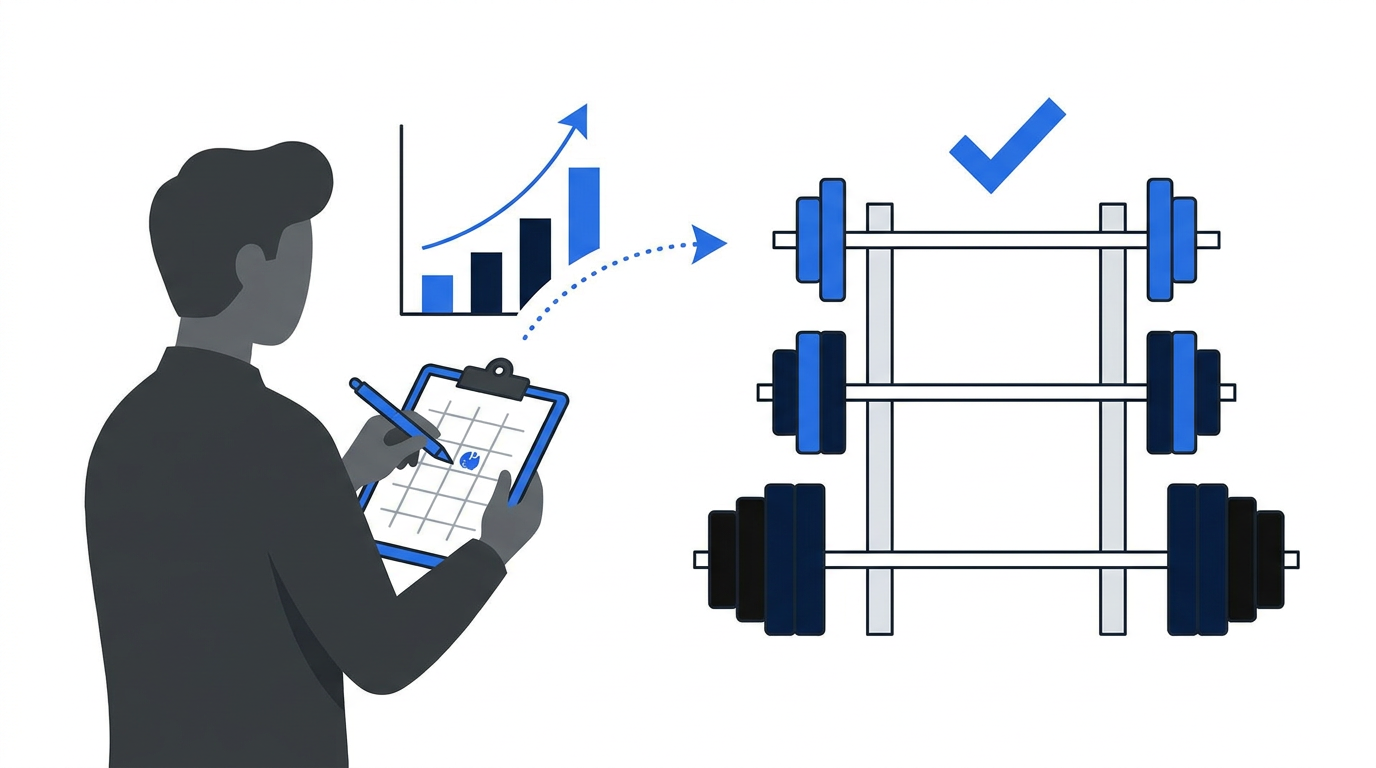
Write down both target RPE and actual RPE. Recording only “165 kg x 1” removes the information needed to understand why that weight should rise, fall, or stay the same next week.
A useful entry for the worked example is “competition squat, 165 kg x 1, target 8, actual 8.5.” Add a brief note if something changed the meaning of the set, such as an unplanned belt change, missed depth, grip adjustment, or pain.
Do not turn the log into a diary of every daily inconvenience. Notes should explain performance or preserve context. “Third rep lost position off the floor” is actionable. “Long day” is less useful unless similar days repeatedly produce the same result.
Review multiple exposures before changing your baseline. One unexpectedly easy session does not prove that your maximum increased. If 165 kg moves at RPE 7.5, RPE 7.5, and RPE 8 across several squat sessions, you have a stronger reason to increase the next starting load.
The RPE and percentage chart can help estimate loads when you lack recent data. Your own training log should gradually become the more relevant chart.
How LiftNlog supports RPE-based powerlifting programming
A spreadsheet can run this process, but it requires you to preserve prescriptions, actual results, and progression logic in a usable format. General workout trackers such as Hevy may record sets effectively, while coaching platforms such as TrainHeroic serve broader training models. A powerlifting-specific tool keeps the squat, bench press, deadlift, and RPE relationship central.
Inside LiftNlog, the workflow begins by selecting from the available powerlifting programs. The scheduled training gives the lift, set and rep requirement, and RPE-based direction needed to choose a load.
At the rack, read the target before warming up. Use recent performance to select the first working weight, complete the set, and record what happened rather than what was supposed to happen. Target RPE and actual RPE serve different purposes, so preserving that difference keeps the log useful.
The next exposure can then be approached with the prior result in view. If the last 165 kg squat single was RPE 8.5, that is better evidence than a generic percentage calculated from an old personal record. The app removes the need to reconstruct that history from scattered notes.
RPE does not mean changing every weight on impulse. The program still supplies structure. Autoregulation operates inside that structure by helping you select a suitable load for the prescribed work.
Review the LiftNlog FAQ for common questions about the platform, or use LiftNlog support when a program or logging issue needs a direct answer. Current plan details are available on the pricing page.
Common mistakes when using RPE in powerlifting
The most common error is rating what a set looked like instead of how many good repetitions remained. Video helps you review technique and speed, but a smooth rep is not always easy, and a slow rep is not always maximal.
Another mistake is treating the target as a required minimum. If a single is prescribed at RPE 8 and the planned weight reaches RPE 9.5, adding weight to “finish the assignment” defeats the purpose of the prescription.
Some lifters rate every successful heavy single as RPE 9 because they cannot picture completing another repetition. Build that skill with occasional rep work at controlled effort. You do not need to take frequent sets to failure, but you do need enough exposure to understand what two reps in reserve feel like.
Ratings can also become self-protective. Calling a difficult set RPE 8 because the program says RPE 8 prevents useful adjustment. Record the honest result. The target describes the plan, while the actual rating describes execution.
Do not compare RPE across unlike variations without context. A 150 kg paused squat at RPE 8 does not mean a 150 kg competition squat will also be RPE 8. Tempo, range of motion, equipment, stance, grip, and rep execution all affect the relationship.
Finally, avoid changing the load because of emotion alone. Feeling unmotivated does not automatically require a reduction. Let warm-ups and bar performance provide evidence. Conversely, feeling excited does not justify turning every RPE 8 single into an RPE 10 attempt.
How to use RPE during powerlifting meet prep
RPE becomes especially useful during meet preparation because fatigue changes as volume rises and then falls. A fixed percentage can overshoot when fatigue is high, while an RPE target can preserve heavy practice without demanding the same absolute weight every week.
Early in a training block, many working sets may sit around RPE 6 to 8. As competition approaches, the program may include heavier singles while keeping them below maximal effort. The purpose is to practice commands, equipment, setup, and heavy technique without repeatedly testing your limit.
Competition standards still apply during these sets. Squats need appropriate depth, bench presses need a controlled pause when prescribed, and deadlifts need a secure lockout. The International Powerlifting Federation technical rules provide official detail on competition execution and commands.
Do not use a good RPE 8 single as automatic proof of an opener. Attempt selection also depends on consistency, technical standard, timing, and the consequences of missing. An opener should be a weight you can execute under meet conditions, not simply the result of an optimistic conversion chart.
A beginner program can use RPE as well, but new lifters need wider tolerances. Rating a set as RPE 7 or 8 is sufficient at first. Half-point ratings add little when technique and effort estimation are still changing rapidly.
RPE in powerlifting FAQ
Is RPE 8 always two reps in reserve?
RPE 8 generally means about two technically acceptable repetitions remained. It is still an estimate. Lift type, rep range, experience, and technique can affect accuracy, so treat it as a decision tool rather than an exact biological measurement.
What weight should I use for RPE 8?
Use a recent result from the same lift and rep range. If you have no history, a percentage chart can provide a starting estimate. Warm up, assess bar performance, and choose a load that should leave approximately two reps in reserve.
For the example lifter with a 180 kg current squat estimate, a 165 kg single is a reasonable RPE 8 starting point. Another lifter with the same maximum may need 160 kg or 167.5 kg because individual rep strength differs.
Should beginners use RPE for powerlifting?
Yes, provided the program does not require false precision. Beginners can use broad targets such as RPE 6, 7, and 8 while learning stable technique. A coach or experienced training partner can help compare perceived effort with visible bar speed and form.
Beginners should not repeatedly train to failure just to calibrate the scale. Consistent submaximal practice provides plenty of opportunities to improve ratings.
What if I rate the RPE incorrectly?
Record your best estimate and continue. Review video afterward if available, then compare the rating with later sets. A single inaccurate score has limited impact when adjustments are modest and the longer training history remains intact.
The bigger problem is repeatedly changing ratings to match what the program prescribed. Honest imperfect data improves. Altered data does not.
Can I use percentages and RPE in the same program?
Yes. Percentages can establish an initial load range, while RPE determines whether that range fits current performance. A program might suggest beginning near a percentage and then adjusting until the prescribed effort is reached.
This combination is particularly useful when a lifter has limited history for a new variation. Generic percentages start the process, and logged RPE results make later selections more personal.
Should I lower the weight if my warm-ups feel bad?
Lower it when warm-up performance provides clear evidence that the planned load will exceed the target. Slower-than-normal movement, unstable positions, pain, or unexpectedly high effort are useful signals.
One awkward light set does not require abandoning the session. Repeat the setup or take the next normal warm-up, then decide. Avoid taking so many diagnostic sets that warm-up fatigue becomes the reason performance declines.
Does RPE replace a structured powerlifting program?
No. RPE controls effort and load selection within a program. It does not decide exercise selection, weekly volume, frequency, progression, or meet timing by itself.
Use a structured program to define the work. Use RPE to execute that work at the intended difficulty. Lifters who want those pieces organized together can review the available LiftNlog programs.
Use RPE as a repeatable loading process
Choose the first load from recent evidence, confirm it through warm-ups, rate the completed set honestly, and adjust the next set only as much as the result requires. Then log both the target and actual RPE.
That process keeps one unexpectedly strong or weak day from controlling the whole program. If you want RPE prescriptions and powerlifting sessions kept in one place, LiftNlog is built for that workflow. If you prefer a spreadsheet, apply the same rules consistently and preserve enough detail for the next decision. Read next: Powerlifting Autoregulation Guide: Adjust Training Without Guessing. Read next: RPE Calculator for Powerlifting: Estimate Load and One-Rep Max. Read next: Powerlifting Autoregulation: How to Adjust Training Without Guessing. Read next: Powerlifting Autoregulation: How to Adjust Training Without Guessing.