
Powerlifting Autoregulation: How to Adjust Training Without Guessing
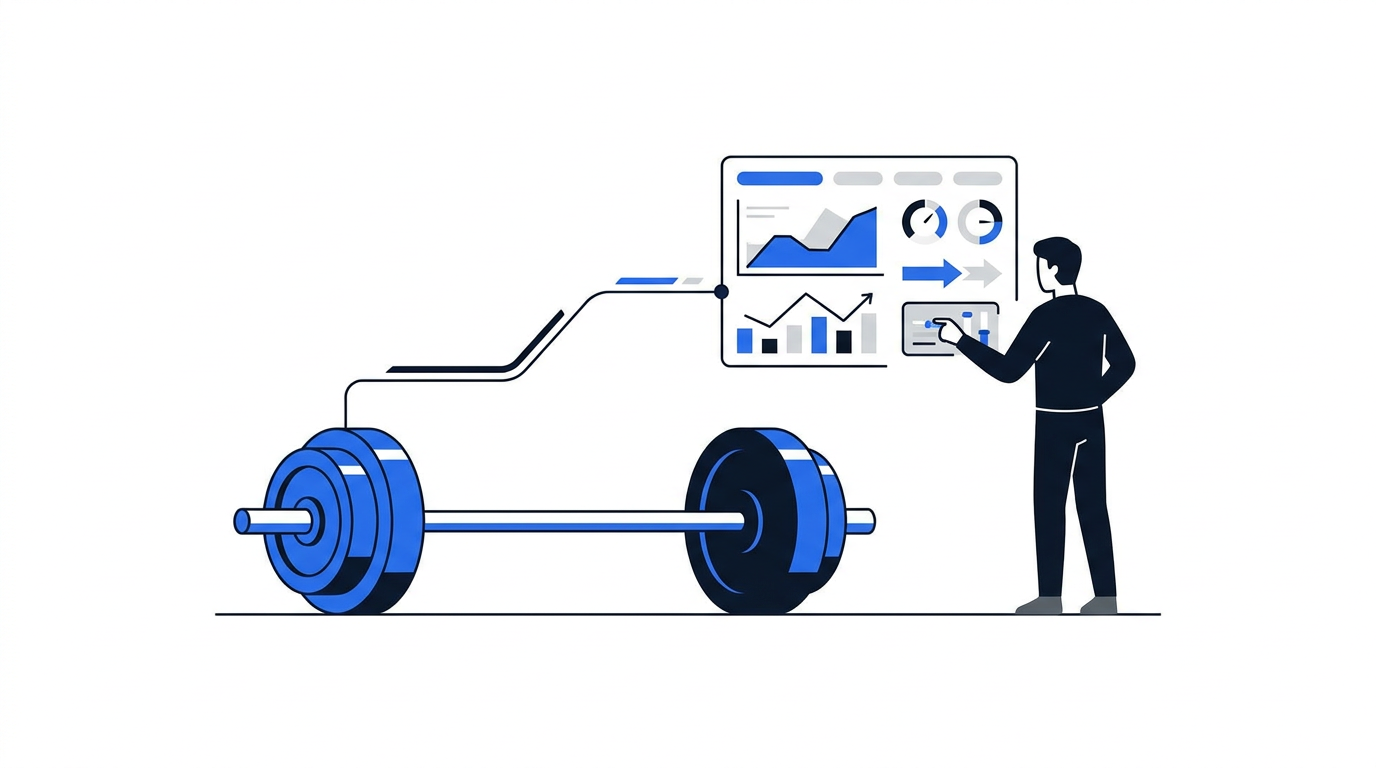
Your program calls for a squat triple at RPE 8, but the final warm-up moves slowly and the planned weight feels like a limit attempt. Following the spreadsheet exactly could create fatigue that affects the rest of the week, while making a random reduction gives you little useful information for the next session.
This powerlifting autoregulation guide shows how to make that decision systematically. LiftnLog can provide a consistent place to record the prescription, actual performance, and resulting adjustment instead of leaving the process to memory.
Quick answer: how to autoregulate powerlifting training
Use this sequence every time performance differs from the written program:
- Set the planned target and adjustment limits before training starts.
- Collect performance feedback from warm-ups, RPE, technique, pain, and completed reps.
- Compare actual performance with the target and check whether the difference is meaningful.
- Adjust the load when the planned weight would miss the intended effort or stimulus.
- Adjust the volume when fatigue changes how many productive sets you can complete.
- Adjust the exercise prescription when technique, pain, or a repeated weakness calls for a different variation.
- Record the decision and update the next session based on the trend rather than one isolated result.
What powerlifting autoregulation actually uses
Autoregulation is a set of prewritten responses to performance feedback. The program still establishes the competition lifts, weekly structure, rep ranges, and intended effort. Feedback determines how that plan is executed on a specific day.
RPE is usually the central input. In strength training, an RPE of 8 generally means the lifter could have completed about two more repetitions. An RPE of 9 leaves roughly one repetition, while RPE 10 indicates no additional repetition was available with acceptable technique.
The repetitions-in-reserve scale has been studied as a practical way to prescribe resistance training intensity. Research on the scale found that trained lifters can use it to estimate effort, although accuracy tends to improve as sets get closer to failure. The full study is available through the National Library of Medicine.
RPE is only one signal. A useful autoregulation decision also considers rep speed, technique, pain, warm-up performance, sleep, recent workload, and whether the lifter completed the prescribed repetitions.
Autoregulation is not improvisation. The adjustment should preserve the purpose of the session whenever possible.
Step 1: Set powerlifting autoregulation boundaries before lifting
Write down what can change before the first warm-up set. Otherwise, a difficult set can produce an emotional response rather than a programming decision.
Suppose a 181 lb lifter has this Monday prescription in week five of a strength block:
- Squat: 405 lb for 3 reps at RPE 8, followed by 3 sets of 4 at 355 lb
- Bench press: 245 lb for 5 reps at RPE 8, followed by 4 sets of 5 at 220 lb
- Maximum same-day load change: 5 percent unless pain or failed reps require stopping
The top set is an effort target, not a promise that 405 lb must be lifted. The back-off work is also adjustable because its purpose is to accumulate technically sound volume, not to force twelve repetitions after an unexpectedly hard top set.
Set a minimum and maximum load, a target RPE range, and a rule for reducing sets. For example, the squat top set may stay between 385 and 415 lb, with back-off volume reduced if the top set exceeds RPE 9.
Those boundaries keep the session connected to the program.
Step 2: Collect performance feedback during the session
Start recording feedback during warm-ups. Do not wait until the heaviest set has already gone wrong.
For the example lifter, 365 lb normally moves quickly. On this Monday, it slows near the sticking point and the lifter reports that it feels like RPE 7 rather than the usual RPE 5 or 6. Sleep was limited to five and a half hours, but there is no pain and technique remains stable.
That information supports a load reduction. It does not automatically justify skipping squats.
Useful session feedback includes:
- Actual load, repetitions, and RPE for the top set
- Whether technique changed as effort increased
- Unusual pain, restricted movement, or loss of control
- Warm-up weights that felt substantially different from normal
- Rest time and any equipment changes that affected performance
- Context such as poor sleep, illness, travel, or an unusually hard previous session
Keep notes short enough that you will use them consistently. A note such as 365 slower than normal, no pain, slept 5.5 hours is more useful than a long diary entry with no clear training implication.
If assigning RPE remains difficult, use the examples in How to Use RPE in Powerlifting before building more complex adjustment rules.
Step 3: Decide whether the performance change is meaningful
A single warm-up can feel wrong because of poor bracing, rushed setup, or inadequate rest. Confirm the signal before changing the entire workout.
Repeat the weight when doing so is safe, take a longer rest period, or make a small jump and reassess. If several indicators agree, act on them. In the example, 365 lb moves slowly, the lifter reports a higher-than-normal RPE, and the next warm-up at 385 lb also feels heavy. The planned 405 lb triple is unlikely to land at RPE 8.
Compare performance with that lifter’s own recent baseline. Two athletes can report the same RPE and require different decisions because one regularly underestimates effort while the other is conservative.
Look for trends across similar sessions:
- Was the same load easier or harder last week?
- Did estimated strength fall across more than one competition lift?
- Is the issue limited to one movement or position?
- Has the athlete exceeded the planned RPE repeatedly?
An estimated one-repetition maximum can help normalize sets performed with different weights and reps. Lifters who need a repeatable calculation can use the RPE calculator for powerlifting, but the result should be treated as an estimate rather than a precise measure of daily strength.
Step 4: Adjust load with an RPE-based rule
Choose a weight expected to produce the original rep and RPE target. Avoid turning a poor-readiness day into an unplanned test.
For the example lifter, the planned squat was 405 lb for 3 at RPE 8. Based on the warm-ups, the load is reduced to 390 lb. The lifter completes three reps at RPE 8.5 with stable depth and bar path. The session still contains a useful heavy triple without the fatigue likely to follow a 405 lb set at RPE 9.5 or 10.
Use small changes first. A reduction of roughly 2.5 to 5 percent is often enough when the difference is one RPE point. Larger reductions may be appropriate after illness, a missed repetition, or a clear technical breakdown.
The following table provides starting rules, not universal laws. Adjust them after observing how accurately the lifter rates effort.
| Performance compared with target | Same-session load decision | Next-session starting point | Reason |
|---|---|---|---|
| 0.5 RPE below target with stable technique | Add 1 to 2 percent if another set is planned | Increase slightly or repeat with more reps | Stimulus was below the planned effort |
| Within 0.5 RPE of target | Keep the planned load | Progress as written | Normal day-to-day variation |
| 1 RPE above target | Reduce 2.5 to 5 percent | Repeat or use a smaller progression | Limits unnecessary fatigue while preserving intensity |
| More than 1 RPE above target or a missed rep | Reduce substantially or end heavy work | Reassess recovery and recent workload | The prescription exceeded current capacity |
| Pain or unsafe technique | Stop the provoking movement | Use a tolerable alternative and seek qualified help when needed | RPE does not override safety |
Do not add weight solely because a set looked fast on video. Ask for the lifter’s RPE and compare it with recent sets. Bar speed and perceived effort can disagree, especially when technique changes.
Step 5: Adjust volume after the top set
Load and volume should be separate decisions. Reducing the top set does not always require cutting back-off work, and completing the planned top weight does not prove the full volume remains appropriate.
In the running example, 390 lb for 3 reaches RPE 8.5. The original back-off prescription was 3 sets of 4 at 355 lb. The first back-off set at 345 lb reaches RPE 8 instead of the intended RPE 7.
The lifter completes one more set at 335 lb and stops after two back-off sets. This removes four repetitions and 20 lb from the original prescription while retaining enough squat volume to practice the competition movement.
A practical volume rule might end back-off work when two conditions appear together: the set exceeds the target by at least one RPE point, and technique deteriorates in a way that changes the training effect. Another option is a percentage drop-off rule based on estimated strength.
Cut low-value fatigue first. Secondary isolation work, extra sets added for progression, or the final back-off set are usually easier to remove than the main competition-lift exposure.
Research-based resistance training recommendations support planned variation in volume and intensity rather than treating one fixed workload as appropriate indefinitely. The American College of Sports Medicine position stand also notes that training status affects how progression should be organized.
Step 6: Change the exercise prescription when the pattern repeats
A difficult session does not justify replacing every exercise. Change a movement when the available feedback points to a specific problem that the existing prescription is failing to address.
Assume the example lifter also performs Romanian deadlifts after competition deadlifts on Thursday. Over three sessions, the lifter’s hips rise early from the floor during heavy conventional deadlifts, but lockout remains strong. Romanian deadlifts add posterior-chain volume, yet they do not give the lifter much practice maintaining position from a dead stop.
For the next block, replace one Romanian deadlift slot with paused deadlifts performed one inch off the floor. Keep the load conservative and set an RPE cap. The exercise changed because the same technical issue appeared repeatedly, not because one workout felt hard.
Exercise changes are also appropriate when equipment is unavailable or a movement consistently causes pain. Do not use autoregulation to train through worsening symptoms. Stop the provoking lift, choose a pain-free option if one exists, and involve a qualified healthcare professional when the issue persists or affects normal movement.
Preserve specificity as a meet approaches. A variation can address a weakness, but competition squat, bench press, and deadlift exposures still need enough space in a powerlifting meet preparation program.
Step 7: Update the next powerlifting session
Record the decision while the session is fresh. Include the original prescription, actual result, reason for the change, and next-session action.
After Monday, the example lifter’s note reads: Planned 405x3 @8. Performed 390x3 @8.5. Back-offs reduced to 2x4 at 335 because first set was @8. No pain. Start next squat exposure at normal warm-ups and target 395x3 @8 if readiness returns.
This note avoids two common overreactions. The program is not permanently reduced after one poor day, and the next week does not blindly jump to the load originally planned for progression.
Review three to six comparable sessions before changing the broader program. If estimated strength rebounds, continue. If squat, bench press, and deadlift performance all decline while RPE rises, reduce fatigue through a lighter week or lower training volume.
How LiftnLog supports powerlifting autoregulation
A spreadsheet can run this process, but it requires the lifter to connect prescriptions, session notes, RPE values, and later decisions manually. A training log becomes more useful when the previous result is visible at the moment a new load must be selected.
Inside LiftnLog, the workflow follows the same order used in this guide. Begin with the planned exercise, load, repetitions, and effort target. During training, record what was actually completed rather than overwriting the original intention. Add the set RPE and a short note when warm-up speed, technique, recovery, or pain changes the decision.
Next, compare the current result with the previous exposure. If last week’s 390 lb squat triple was RPE 8.5 and this week’s 395 lb triple is RPE 8 with better technique, the progression has support. If the same load rises to RPE 9.5, hold or reduce it and inspect recent volume before adding more work.
Then apply the adjustment to the relevant lever. Change load when current strength differs from the prescription. Change the number of sets when fatigue reduces the value of later work. Change the exercise only after the log shows a repeated technical need, tolerance issue, or mismatch between the variation and its purpose.
Review the current LiftnLog features to see how the available logging workflow fits your program. Before choosing any tracker, test whether it lets you preserve both planned and completed work. If it stores only completed sets, you lose the comparison that makes autoregulation useful.
General workout trackers such as Hevy can record lifting sessions, while coaching platforms such as TrainHeroic focus on delivering programs to athletes. Barbell Medicine offers its own training products and RPE-based programming. Check each vendor’s current product and pricing pages directly, then compare them with LiftnLog pricing based on the workflow you actually need.
Common mistakes in powerlifting autoregulation
The most frequent mistake is adjusting from mood instead of performance. Feeling tired before training may justify closer monitoring, but the warm-ups and working sets should still inform the decision.
Another failure mode is raising load aggressively on every good day. A top set that lands at RPE 7 instead of RPE 8 can support a small increase. It does not require a personal-record attempt. Save enough capacity to complete the planned volume and recover for the next session.
Some lifters adjust only load. They reduce the top set after poor warm-ups, then force every back-off set at the original percentage. Others do the reverse by completing a maximal top set and cutting all remaining work. Both choices can distort the intended stimulus.
RPE inflation and deflation also matter. If every difficult set is called RPE 10, the program will repeatedly prescribe loads that are too light. If missed repetitions arrive after reported RPE 8 sets, the ratings are too low. Compare ratings with video, technique, and repeated performance.
Finally, avoid changing several variables at once. If load, set count, exercise variation, frequency, and rest periods all change together, the next result cannot show which decision helped.
Powerlifting autoregulation for beginners and meet prep
Beginners can use autoregulation, but the adjustment range should be narrow. New lifters are still learning how hard a set feels, and technique improvements can make strength appear to change rapidly.
Give a beginner a fixed rep target, a small load range, and clear stop rules. For example, prescribe 3 sets of 5 at RPE 6 to 7 and allow a load change of up to 5 percent. Keep the competition-lift selection stable long enough to develop consistent technique.
More experienced lifters can use wider load ranges and more detailed volume adjustments because they have a stronger performance baseline. They should still avoid daily program redesign.
During peaking and meet preparation, specificity increases and tolerance for missed heavy repetitions decreases. Use autoregulation to keep singles near the intended effort. A planned single at RPE 8 should remain an RPE 8 single even if that requires less weight than expected.
Meet attempts are a separate decision. Training estimates can inform attempt selection, but commands, equipment, timing, and competition conditions matter. Use the final heavy sessions to confirm a range rather than forcing a number needed to satisfy a spreadsheet.
Powerlifting autoregulation FAQ
How often should I change my powerlifting loads using RPE?
Assess every working set, but change the load only when performance falls outside the planned range. If the target is RPE 8 and the set lands between 7.5 and 8.5 with good technique, continuing as written is usually reasonable.
Should I use percentages or RPE for powerlifting?
Use both when possible. Percentages provide structure based on established strength, while RPE accounts for daily performance. A program might prescribe a triple around a percentage of one-repetition maximum, then use an RPE cap to determine the exact load.
What if I am bad at judging RPE?
Start rating only the final warm-up and working sets. Record the rating before watching video or asking for feedback, then compare it with rep speed, technique, and whether another repetition was actually available. Accuracy improves through repeated calibration.
Can autoregulation make a program too easy?
Yes. Constantly reducing loads because a warm-up feels uncomfortable can remove the overload needed for progress. Set minimum ranges and require objective evidence, such as elevated RPE across multiple warm-ups or deteriorating technique, before making a large reduction.
Is autoregulation suitable for a powerlifting peaking program?
Yes, provided the competition lifts and intended intensities remain specific. Autoregulation is especially useful for keeping heavy singles below maximal effort. It should control fatigue, not replace the structure of the peak.
When should I contact LiftnLog for help?
Use the LiftnLog support page for product assistance or the contact page for questions that are not covered in the documentation.
Make the next adjustment from recorded evidence
Choose a simple rule set and use it for several weeks. Record the target, actual performance, reason for any adjustment, and next action. That gives you enough evidence to change load, volume, or exercise selection without rewriting the program after every unusual session.
For lifters who already use RPE and want session history to inform the next prescription, LiftnLog is the practical choice. Lifters who do not yet record consistent RPE and technique notes should start there first. The quality of an adaptive decision cannot exceed the quality of the feedback behind it.