
Powerlifting Autoregulation Guide: Adjust Training Without Guessing
Your program calls for a squat single at RPE 8, but the final warm-up moves slowly and the planned load feels like a near-max attempt. Following the spreadsheet exactly could ruin the back-off work, while making a large unplanned reduction could remove the training stimulus.
A useful powerlifting autoregulation guide needs to resolve that decision while keeping the broader program intact. LiftNlog approaches programming around that session-by-session relationship between prescribed work and recorded performance.
Quick answer: How powerlifting autoregulation works
Use this workflow to adjust training from one session to the next:
- Establish the intended stimulus, target RPE, rep range, and acceptable load range.
- Record the completed load, reps, RPE, technique, and relevant recovery information.
- Adjust load when performance falls outside the planned RPE range.
- Change volume only when fatigue or performance indicates that the planned sets are no longer productive.
- Modify an exercise when pain, repeated technical failure, or a specific weakness calls for a different prescription.
- Review trends across several sessions before changing the wider program.
- Apply the same process in a programming app so each new prescription uses the latest feedback.
Start powerlifting autoregulation with a clear prescription
Autoregulation does not mean deciding what to do after entering the gym. Each session still needs a defined purpose.
A complete prescription might read: work to one squat single at RPE 8, then complete four sets of four at 77 to 80 percent of the day’s top single. That gives the lifter a target, a way to judge the result, and boundaries for adjusting it.
Consider Maya, an illustrative 75 kg powerlifter preparing for a local meet. Her Monday squat session calls for a 145 kg single at RPE 8 followed by four sets of four at 112.5 kg. Her previous two singles at that load were both recorded near RPE 8, so the prescription is grounded in recent performance.
This is very different from writing “heavy squat” and choosing plates based on motivation. There is no useful feedback unless the original target is specific.
The prescription should define load or load range, sets, reps, target RPE, exercise variation, and the reason for the work. For Maya, the single provides exposure to a heavy competition squat. The back-off sets supply most of the strength volume. Protecting the quality of those sets matters more than forcing one predetermined number.
Progressive resistance training depends on planned changes to training stress, not constant maximal effort. The American College of Sports Medicine position stand describes progression through variables including load, volume, frequency, rest periods, and movement velocity. Autoregulation gives lifters a structured way to change those variables when actual readiness differs from the forecast.
Record useful feedback for powerlifting autoregulation
The completed weight alone is not enough. Log what happened and how demanding it was.
Maya sleeps poorly before Monday’s session. Her warm-ups through 125 kg look normal, but 137.5 kg moves more slowly than expected. She still takes 145 kg, completes it with acceptable depth, and records RPE 9.5 instead of the prescribed RPE 8.
That entry contains several useful facts. The target was missed by 1.5 RPE points, the rep was technically valid, and the slowdown appeared before the top set. This looks more like reduced readiness than a sudden loss of squat strength.
Record RPE immediately after the set, before seeing what the program recommends next. Waiting until the end of the workout encourages lifters to rewrite the rating based on whether they completed everything.
Technique also needs a short, consistent description. “Hips rose first” is useful. “Felt bad” is not. Video can confirm depth, pauses, lockouts, and obvious changes in bar path, but it cannot show how many repetitions the lifter had left.
RPE should reflect repetitions in reserve rather than discomfort. An RPE 8 set generally means about two good repetitions remained, while RPE 10 means another repetition was not available. Research introducing a repetitions-in-reserve scale for resistance exercise found that trained lifters could use it to report effort across sets, although accuracy is naturally better near failure than far from it. The study is available through the National Library of Medicine.
For a fuller explanation of assigning ratings, use this practical guide to RPE in powerlifting.
Adjust powerlifting load without overreacting
When a top set lands outside the target range, change the load enough to restore the intended effort. Do not turn one difficult rep into a new assessment of the athlete’s entire strength level.
After Maya records 145 kg at RPE 9.5, repeating or increasing the load would miss the session’s purpose. She reduces the first back-off set from 112.5 kg to 107.5 kg, close to a 4 percent change. The set lands at RPE 7.5 with stable technique.
She keeps 107.5 kg for the next set. There is no need to cut another 10 kg merely because the top single was harder than expected.
Use small jumps. For squat and deadlift, a reduction around 2.5 to 5 percent will often be enough to move a set back into its target range. Bench press may require a smaller absolute change because each plate increment represents a larger share of the load. These are starting ranges, not universal rules.
An unexpectedly easy set can justify an increase too. If Maya completes a prescribed 75 kg bench single at RPE 6.5 when the target was RPE 8, moving to 77.5 kg is reasonable if another single fits the session plan. Jumping directly to 82.5 kg would make the rating a license to test rather than a tool for matching the prescription.
Use the smallest adjustment likely to solve the mismatch. Then rate the next set again.
A practical RPE response table
The following table translates common performance results into immediate decisions. It assumes technique is acceptable and there is no pain.
| Set result compared with target | Likely meaning | Load decision | Volume decision |
|---|---|---|---|
| 1.5 or more RPE below target | Load is too light or readiness is unusually high | Add a small increment within the planned range | Keep planned sets unless the session includes another top set |
| 0.5 to 1 RPE below target | Normal positive variation | Hold or increase slightly | Keep planned volume |
| Within 0.5 RPE of target | Prescription matched performance | Keep the load | Complete planned volume |
| 1 RPE above target | Readiness is lower or load selection was aggressive | Reduce the next set by roughly 2.5 to 5 percent | Continue if performance stabilizes |
| 1.5 or more RPE above target | The intended stimulus was missed | Reduce load immediately | Consider removing one set if back-off performance remains poor |
| Technical failure or pain | The set cannot be judged by effort alone | Stop adding weight | Change or end the exercise after assessing the problem |
Percentages are guardrails. Plate availability, exercise selection, rep count, and the athlete’s history should shape the final number.
Change powerlifting volume when set quality deteriorates
Load and volume solve different problems. Reducing weight can bring effort under control, but it does not guarantee that every planned set remains useful.
Maya’s first two back-off sets at 107.5 kg are both around RPE 7.5. The third reaches RPE 9 and shows the same hips-first pattern noted on her top single. A fourth set would add repetitions, but they would no longer match the planned moderate-effort volume.
She ends the squat work after three back-off sets. That removes four repetitions from the session while preserving 12 productive repetitions.
Do not remove volume just because the top set was hard. First lower the load and observe the response. Cut a set when effort continues to rise quickly, technique becomes less repeatable, rest periods must expand well beyond normal, or a known recovery issue is affecting the session.
The opposite decision also needs restraint. An easy top set does not automatically justify extra sets. Volume additions create fatigue that can affect the next bench or deadlift session even when the current workout feels excellent. Add volume only when the program defines an acceptable range, such as three to five sets, or when repeated data shows the athlete is consistently recovering below the planned workload.
Volume is usually slower to change than load. Loads can move within a session. Weekly set targets should generally respond to a pattern.
Modify powerlifting exercises for a specific reason
Exercise selection should not change whenever a competition lift feels awkward. Frequent variation makes it harder to compare performance and develop skill in the squat, bench press, and deadlift.
Modify an exercise when there is pain, a repeated technical limitation, equipment constraints, or a phase-specific reason. Each cause leads to a different substitution.
Suppose Maya reports sharp hip pain during her next squat warm-up. Reducing the bar from 120 kg to 100 kg is not adequate if the pain remains. She stops the competition squat rather than using RPE to train through it. A tolerable alternative may be selected after appropriate assessment, but it should not be presented as treatment. Persistent or severe pain belongs with a qualified healthcare professional.
Now consider a different scenario. Maya is pain-free, yet three weeks of video show that she loses position immediately above parallel. A temporary paused squat prescription can provide more practice controlling the bottom position. The variation uses less weight, so its RPE and load history must be tracked separately from the competition squat.
During meet preparation, specificity becomes more important. Competition-standard technique, commands, equipment, and attempt timing should receive priority. The International Powerlifting Federation technical rules provide a useful reference for judging requirements, even if the athlete competes in another federation with different rules.
Review powerlifting autoregulation across several sessions
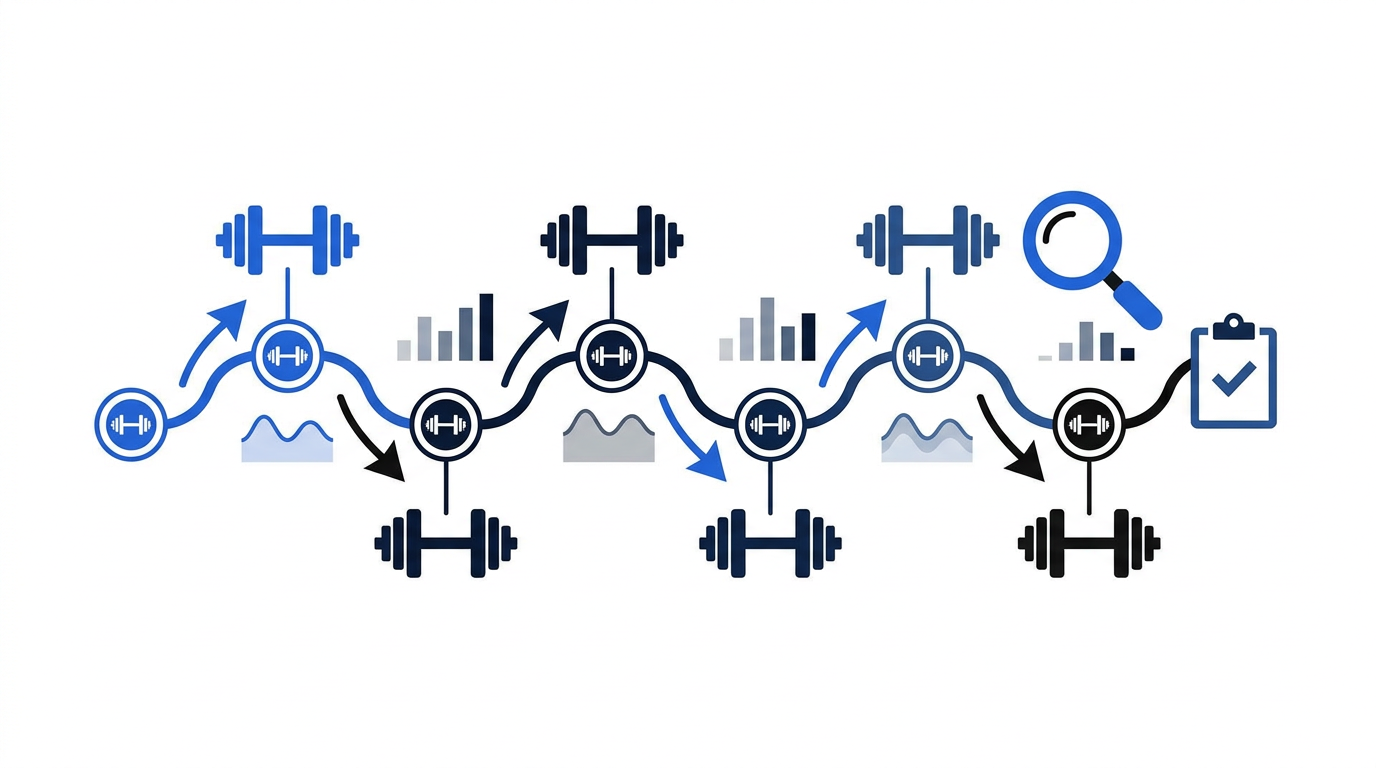
One bad session is information. Three or four similar sessions may indicate that the program needs revision.
After Maya’s difficult Monday, her Thursday bench work matches every target and her Friday deadlift single is only 0.5 RPE above the prescription. The poor squat session now looks isolated. Her next Monday squat should not start with a permanent 5 percent reduction.
Instead, she keeps the planned progression but uses the final warm-up as a checkpoint. If 137.5 kg moves normally, she can attempt the scheduled 147.5 kg single. If it again looks and feels close to maximal effort, she can repeat 145 kg or choose 142.5 kg.
Compare the same movement under similar conditions. A paused squat estimated maximum should not be merged with a competition squat maximum. Sets of eight should not drive the same conclusions as heavy singles because RPE accuracy and fatigue behave differently across rep ranges.
Review at least these signals together: target versus actual RPE, completed load and reps, missed repetitions, recurring technique notes, and whether planned volume was completed. Body weight, sleep, and soreness can provide context, but they should not become automatic excuses or rigid readiness scores.
If the same lift misses its target for several exposures, revise the baseline. The cause could be an inflated training max, excessive weekly volume, poor exercise placement, inadequate recovery, or a weakness that the current prescription does not address. Read the notes before lowering every load in the program.
How LiftNlog applies powerlifting autoregulation
A spreadsheet can support this workflow, but the athlete has to preserve the rules, carry feedback forward, and avoid overwriting the original prescription. An RPE-based programming app removes part of that administrative work without removing the lifter’s judgment.
In LiftNlog’s powerlifting programs, the athlete begins with a structured program rather than an empty workout log. The session provides the exercise and intended work. That preserves the purpose of the day before readiness influences any decision.
During training, the lifter records the completed performance and RPE. If Maya’s 145 kg squat is entered at RPE 9.5, the record reflects what happened instead of treating the prescribed and completed sessions as identical.
That performance feedback can then inform the load, volume, and exercise prescriptions that follow. The useful part is continuity. Maya does not have to remember whether last Monday’s reduction came from a difficult single, poor back-off technique, or a planned change. The training history keeps the prescription beside the result.
The athlete still checks the recommendation against pain, equipment, meet rules, and circumstances the log cannot interpret. Autoregulation is not an automatic command to add or remove weight. It is a decision system supported by current information.
Review the next session before training. Confirm that the recommended work still serves the current phase, then complete and rate it. Repeating that sequence creates a personalized program from actual training responses rather than from repeated max tests.
Athletes who need help with account or workflow questions can use LiftNlog support, while common product and programming questions are covered in the LiftNlog FAQ.
Common powerlifting autoregulation mistakes
The first common error is rating the weight instead of the effort. A load that used to be an RPE 8 is not permanently an RPE 8. Rate the set performed that day.
Another error is treating every high RPE as proof of lost strength. Poor sleep, short rest periods, rushed warm-ups, unfamiliar equipment, and a simple rating mistake can all affect one result. Make an immediate adjustment to protect the session, but reserve program-wide changes for a trend.
Some lifters adjust too many variables at once. They reduce the load, remove two sets, and replace the exercise after one difficult top set. That makes the next result impossible to interpret. Change the smallest relevant variable first.
RPE can also become permission to avoid demanding work. An RPE 8 single is still heavy. If a lifter repeatedly labels challenging but repeatable sets as RPE 9.5, the program will drift downward. Compare ratings with video, rep speed, later sets, and previous sessions. Calibration improves through honest repetition.
The reverse pattern is just as damaging. Competitive lifters may report an obvious maximum as RPE 8 because the rep was completed. Use the question, “How many technically acceptable repetitions remained?” A grinder with no realistic second rep is RPE 10 even if the bar never stopped.
Finally, do not use estimated one-rep maximums as the sole decision tool. Estimation formulas can be helpful when the exercise, rep range, and RPE method remain consistent, but they produce noisy outputs. Keep the completed work visible beside the estimate.
Powerlifting autoregulation for beginners and meet preparation
Beginners can use autoregulation, but they need narrower choices. Technique and rating accuracy are still developing, so a coach or program should set clear load limits.
A beginner squat prescription might provide a target RPE 7 and permit one small increase if the first work set is clearly below RPE 6. If the set exceeds RPE 8, the lifter reduces the load and repeats it. This teaches effort rating without turning every workout into open-ended load selection.
Beginners should prioritize repeatable technique and completed volume over estimated maximums. Their strength can change quickly, and unfamiliarity often makes repetitions-in-reserve ratings inconsistent. The detailed guide on how to use RPE for powerlifting loads is a useful companion when establishing that skill.
Meet preparation changes the trade-off. Heavy singles become more specific and fatigue carries a higher cost as competition approaches. Autoregulation can keep a planned single from becoming an accidental maximum, but it should operate inside a peaking plan.
Attempt selection must remain separate from ordinary gym progression. A successful heavy single two weeks out does not require another jump if the goal is to reduce fatigue and arrive prepared. During the final weeks, preserving confidence, technical consistency, and recovery may be more valuable than adding 2.5 kg to a training lift.
Powerlifting autoregulation FAQ
How do I use RPE in powerlifting without guessing?
Define the target before loading the bar, rate repetitions in reserve immediately after the set, and compare the result with recent sets of the same lift. Use video to check technique, not to pretend that bar speed reveals effort perfectly. Start with heavy sets of one to five repetitions, where remaining reps are usually easier to estimate.
Should I lower the weight after one set above the target RPE?
Usually, yes, if more work remains and the miss is meaningful. A set prescribed at RPE 8 but rated RPE 9.5 should prompt a small reduction for the next set. If the rating is only 0.5 above target and technique is stable, holding the load may be appropriate.
The change applies to the current session first. Do not lower the entire training block because of one result.
Can autoregulation replace a powerlifting program?
No. Autoregulation needs a planned stimulus to regulate. The program determines exercises, weekly structure, progression, and phase goals. Performance feedback changes how that plan is expressed on a particular day.
Without a program, RPE often becomes reactive training based on mood. Choose a structured option from the available powerlifting programs, then use feedback to keep the work aligned with its purpose.
How much should I reduce a load when RPE is too high?
Start with the smallest practical reduction. Around 2.5 to 5 percent is a reasonable response when a work set overshoots its target by approximately one RPE point or more, but the correct adjustment depends on the lift, rep range, plates available, and athlete.
Rate the next set. If it returns to the target range, hold there instead of continuing to reduce the weight.
Is autoregulation useful for a powerlifting peak?
Yes, especially for preventing prescribed heavy singles from becoming maximal attempts. Set a target RPE and a firm load ceiling before the session. Reduce the load when warm-ups or the first attempt show that readiness is below expectations.
Do not add unplanned volume late in a peak because one session feels easy. The benefit of extra work must be weighed against fatigue and proximity to the meet.
When should I change the whole program instead of one workout?
Change the wider program when comparable sessions show a repeated mismatch between prescription and performance. Look for several exposures with high RPE, incomplete volume, recurring technical breakdown, or stalled load progression.
First check whether the training maximum and ratings are accurate. Then examine weekly volume, exercise order, recovery demands, and variation selection. If product behavior or program setup is unclear, contact LiftNlog before repeatedly editing the plan around a configuration problem.
Make the next session respond to the last one
A good autoregulated powerlifting program remains recognizable from week to week. The exercises and phase goals provide direction, while completed loads, RPE, volume tolerance, and technique determine the next appropriate step.
Record the result accurately. Adjust one variable at a time. Let isolated bad days pass, but act when a pattern becomes clear.
Lifters who want that feedback connected to an RPE-based program can review LiftNlog pricing. Those who prefer manual tracking can use the same workflow in a training log, provided they preserve both the original prescription and the completed result. Read next: RPE Calculator for Powerlifting: Estimate Load and One-Rep Max. Read next: Powerlifting Autoregulation: How to Adjust Training Without Guessing.