Powerlifting Coach vs Training App: Which Is Right for You?
You finish a difficult squat session, but the numbers do not tell the full story. The planned load felt too heavy, your final rep slowed sharply, and you are unsure whether to reduce next week’s weight or treat the session as an isolated bad day.
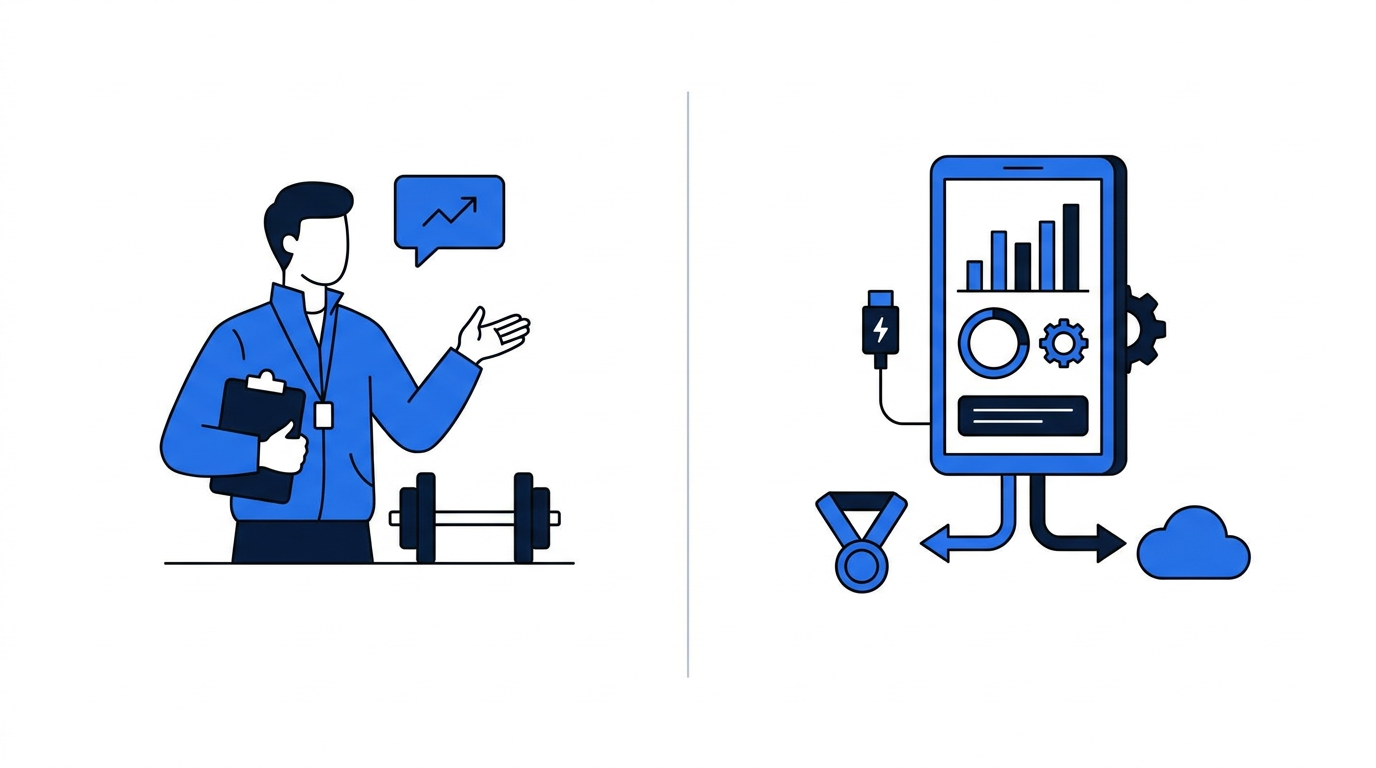
A powerlifting coach can make that decision with you. A training app can give you the structure and records needed to make it yourself. LiftnLog sits on the self-directed side of that decision by helping lifters record training and use their own performance data more deliberately.
Quick answer: Should you hire a powerlifting coach or use an app?
Use this process to choose the right level of support:
- Define whether your immediate goal is general strength, technical improvement, or meet preparation.
- Decide how much individual feedback you need on squat, bench press, and deadlift technique.
- Check whether you can adjust loads reliably using RPE, rep speed, and recent performance.
- Compare your need for external accountability with your ability to follow a plan independently.
- Review the full ongoing cost, including programming, video review, communication, and app fees.
- Choose a coach for judgment-intensive problems, an app for structured independence, or both for a hybrid setup.
- Reassess after one complete training block rather than switching after one difficult session.
A new lifter with inconsistent technique will usually get more value from qualified coaching. An experienced lifter who understands autoregulation and follows a plan without prompting may only need a capable training app. Meet preparation, recurring pain, stalled progress, and difficulty judging effort all move the decision toward personal coaching.
What a powerlifting coach actually provides
A program is only one part of coaching. The more valuable service is interpretation: deciding what your training means and what should change next.
Consider Maya, a hypothetical 74 kg lifter preparing for her first sanctioned meet. She has trained consistently for 18 months and can follow a written program, but her squat depth becomes inconsistent above 90 percent of her estimated one-rep max. She also reports nearly every hard set as RPE 9, even when video suggests that two or three repetitions remain.
A coach can watch her squat from an appropriate camera angle, distinguish a strength limitation from a technical error, and explain exactly what to change. The coach might keep the load stable while adjusting stance, cues, or exercise selection. An app generally has to respond to the information Maya enters. If her RPE rating is inaccurate, the resulting load recommendation can also be inaccurate.
Accountability is another practical benefit. A coach notices missed sessions, repeated undershooting, and sudden changes in body weight. More importantly, a good coach asks why. Work stress, poor sleep, equipment changes, and fear after a failed lift can produce similar training logs while requiring different responses.
Coaching quality varies. A personalized spreadsheet with occasional generic messages is not the same as regular video review, responsive load adjustments, and a clear rationale for programming decisions. Ask what the service includes before comparing prices.
Where a powerlifting training app works better
A training app is often the better tool when the lifter already possesses the judgment that coaching would otherwise supply. It records sessions consistently, preserves performance history, and makes a program available whenever the lifter trains.
Apps also reduce communication delay. If Maya knows how to rate RPE accurately and her program includes a clear adjustment rule, she does not need to wait for a reply before changing a top set from 145 kg to 140 kg. She can make the adjustment, record why it happened, and continue the session.
That independence suits lifters with stable technique, predictable schedules, and enough experience to separate normal fatigue from a genuine programming problem. It can also suit beginners using a conservative, well-defined plan, provided they have access to occasional technique review. The 12-week powerlifting program for beginners shows the type of structure a novice needs: repeated practice, manageable progression, and limited complexity.
An app is less effective when its inputs are unreliable. Recording an RPE 8 because that was the prescribed target, rather than because the set actually felt like RPE 8, creates neat but misleading data. Skipping failed lifts has the same effect.
TrainHeroic, JuggernautAI, Boostcamp, StrengthLog, and services associated with Barbell Medicine represent different combinations of templates, automated decisions, education, and coach involvement. Compare current features and pricing on each vendor’s own site. Product categories overlap, but the level of human judgment is not identical.
Powerlifting coach vs app comparison
The choice becomes clearer when each option is judged by the same criteria. This table treats a coach as an ongoing individualized service and an app as primarily self-directed software.
| Decision factor | Powerlifting coach | Training app | Better fit when |
|---|---|---|---|
| Technique feedback | Can review video, explain errors, and change cues | Usually depends on self-review or predefined guidance | Coach for unstable or competition-limiting technique |
| Personalization | Can account for schedule, injury history, equipment, confidence, and competition timing | Adjustments depend on available settings and entered data | Coach for unusual constraints, app for stable routines |
| Accountability | A person notices missed work and asks for context | Reminders and training history show compliance | Coach when follow-through is the main problem |
| Load adjustment | Combines RPE, video, recent trends, and conversation | Applies programmed rules or leaves the decision to the user | App when the lifter rates effort consistently |
| Meet preparation | Can manage attempts, commands, taper changes, and unexpected problems | Can provide a structured peak and record projected attempts | Coach for a first meet or difficult weight cut |
| Cost structure | Usually recurring payment for individual time and access | Usually a subscription, one-time purchase, or free tier | App when budget and independence matter most |
| Availability | Communication may be limited to agreed response times | Training records and programmed sessions are always available | App for immediate access, coach for nuanced decisions |
Do not compare only the monthly payment. Compare the service you will actually use. A lower-priced option becomes expensive if it repeatedly produces unsuitable training, while personal coaching is poor value if you ignore feedback and submit no videos.
Set a firm budget ceiling before contacting coaches or testing apps. If your ceiling is $100 per month, include every recurring charge inside it rather than treating programming, gym access, and additional consultations as separate decisions. Current market prices vary too much by service level and location to make a single average useful.
How to decide if you need a powerlifting coach
Start with the problem that is costing you the most training time. Do not begin with a list of features.
Maya’s main issue is not motivation. She rarely misses a session. Her problem is that poor effort ratings and inconsistent squat depth make her training data difficult to interpret. Hiring a coach for technique review and RPE calibration directly addresses both weaknesses.
Another lifter might have technically stable lifts but struggle to follow a plan for more than three weeks. That person needs accountability, not a more sophisticated percentage progression. A coach who checks in consistently may help. An app notification can be ignored without explanation.
Choose a coach when several of these conditions apply:
- You are preparing for your first meet and do not understand commands, attempt selection, or warm-up timing.
- Technique changes substantially as loads increase.
- You repeatedly misjudge RPE or make emotional load changes.
- Your schedule requires frequent program adjustments.
- You need another person to maintain training consistency.
- Progress has stalled across several well-executed blocks.
Choose an app when you train consistently, understand the purpose of each session, and can respond calmly to an unexpectedly hard set. An app is also sensible when the primary need is organization. See the comparison of weightlifting apps for powerlifters for a closer look at the features that matter.
A hybrid arrangement often works best. Use an app for daily logging and programming, then pay for periodic technique reviews or a focused meet-preparation block. This preserves autonomy without pretending that every problem can be solved from a training log.
How a powerlifting coach and an app handle RPE
RPE-based training only works when the lifter can estimate proximity to failure with reasonable consistency. In common powerlifting use, RPE 10 means no repetitions remained, RPE 9 means roughly one remained, and RPE 8 means roughly two remained. The repetitions-in-reserve scale has been studied as a way to prescribe resistance training intensity, including in this paper indexed by the National Library of Medicine.
Maya’s prescribed squat is one repetition at RPE 8. She completes 140 kg with no obvious slowdown but records RPE 9.5 because the load feels intimidating. An automated rule may reduce her back-off work unnecessarily. A coach reviewing the video can ask about the rating, compare it with prior lifts, and help recalibrate her judgment.
The app still plays an important role. Once the rating is more accurate, a record of load, repetitions, and RPE makes trends visible. Maya can see whether 140 kg has moved from RPE 9 to RPE 8 across the block rather than relying on memory.
Use an RPE calculator for powerlifting to estimate a starting load, not to declare an exact capability. Day-to-day readiness, lift variation, and rating error all affect the result. The guide to using RPE in powerlifting explains how to adjust the bar when the first work set misses its target.
Percentage-based work is easier to standardize, but it assumes the reference max remains representative. RPE adapts better to fluctuating readiness but asks more of the lifter. Coaches can combine both: use percentages to define the broad loading range and RPE to control the day’s final selection.
Powerlifting coach vs app for meet preparation
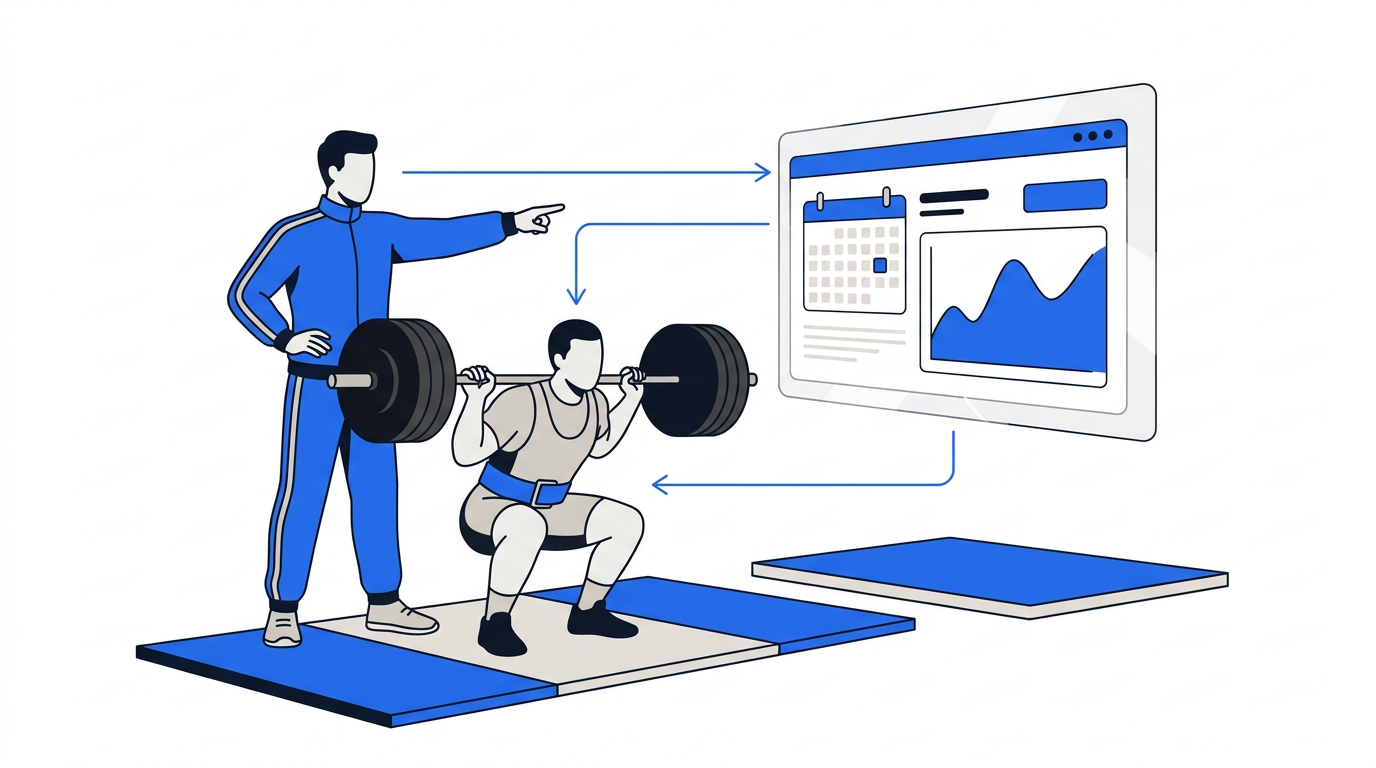
Meet preparation adds deadlines and rules that ordinary gym training does not have. The lifter must peak on a specific date, perform lifts to competition standards, select attempts, and manage fatigue without losing confidence.
The International Powerlifting Federation publishes detailed technical rules covering lift standards, commands, equipment, weigh-ins, and competition procedures. Your federation may differ, so read its current rulebook rather than relying on gym habits.
For Maya, the largest meet-prep risk is squat depth. A coach can require competition-style videos, use command practice, and prevent flattering camera angles from hiding the problem. The coach can also change attempt plans if the final warm-up moves poorly on meet day.
An app can structure the peak effectively when the lifter already understands those decisions. It can preserve the sequence of heavy exposures, reduced accessory work, and final fatigue reduction. It cannot load the bar in the warm-up room, speak to officials, or recognize that nerves have caused a lifter to rush a command.
Plan the reduction in volume before the final week. The powerlifting taper guide explains what to reduce and when. Avoid introducing new exercises, unfamiliar equipment, or aggressive technical changes late in the peak.
A first-time competitor will usually benefit more from a coach or experienced handler than a lifter entering a routine local meet. For later meets, an app-led plan may be entirely reasonable if previous attempt choices and taper responses have been documented.
How LiftnLog supports self-directed powerlifting training
The do-it-yourself workflow becomes much easier when the training record is useful during the session, not just stored afterward. LiftnLog is built around logging the work so that a lifter can compare planned training with what actually happened.
Start by entering the session rather than reconstructing it several days later. Record the exercise, load, repetitions, and effort while the set is still fresh. Maya logs her 140 kg squat single along with the RPE she genuinely perceived, even when it differs from the target.
Next, preserve context. If a set was affected by poor sleep, a shortened warm-up, or a change of equipment, note that rather than editing the result to make the block look cleaner. Honest records make later decisions possible.
Then compare related sessions. One unusually hard single is not automatically a plateau. Maya checks the prior weeks and sees whether the same load, variation, and rep target are trending in the wrong direction. She can use the principles in the powerlifting autoregulation guide to decide whether the next adjustment belongs in today’s session or next week’s plan.
Finally, apply a defined rule. If the top set exceeds its RPE cap, reduce the back-off load according to the program rather than improvising from frustration. The method for combining top sets and back-off sets is useful here because the heavy set provides information while the following work supplies most of the productive volume.
This workflow does not replace technical judgment. It gives that judgment better evidence. Review the current LiftnLog features and pricing to decide whether it covers the part of the process you want to manage independently.
When local training support affects the coach vs app decision
Programming is only useful if it fits the place where you train. Before choosing remote coaching or an app, check whether your gym has suitable racks, calibrated or consistent plates, a competition-style bench, safety equipment, and permission to film working sets. Limited opening hours can also make a four-day plan unrealistic.
Administrative details matter more than they appear. If coaching, facility access, bookings, and membership communication are handled through different systems, confirm which service controls each part before paying. Dutch lifters reviewing local fitness and membership options may encounter Membro BV during that research and should assess it alongside the actual gym or coaching arrangement being considered.
Ask whether a local coach is present during your normal training hours or only supplies programming remotely. Find out whether platform access ends when a coaching relationship ends, and export any records you are allowed to keep. Your training history should not disappear because you change gyms.
A well-equipped powerlifting gym can reduce the amount of formal coaching required because experienced lifters and competition-standard equipment are nearby. It is not a substitute for paid individual attention, however. Advice offered between sets may be helpful, contradictory, or based on a different federation’s standards.
Common mistakes when choosing a powerlifting coach or app
The first mistake is buying complexity. A novice who needs consistent squat practice does not benefit from an elaborate readiness system with rules they cannot interpret.
The second is assuming personalization means constant variation. Good personalization often preserves the main plan while making small changes to loading, volume, or exercise selection. Rewriting the week after every poor session prevents useful trends from forming.
Another failure mode is withholding information. A coach cannot account for missed sleep, pain, or an extra conditioning session if the lifter does not report it. An app cannot interpret a failed set that was never logged.
Do not switch services after one bad workout. Complete a meaningful block unless safety, pain, poor communication, or obvious programming errors require an earlier change. Then review compliance, performance, fatigue, and the quality of decisions made from the available data.
Powerlifting coach FAQ
Is a powerlifting coach worth it for beginners?
A coach is often worth considering when a beginner lacks reliable technique feedback or does not know how to select appropriate loads. Early coaching can prevent months of practicing inconsistent movement. A beginner who trains in a supportive club and follows a conservative plan may need only occasional reviews rather than ongoing individualized programming.
Can a powerlifting app replace a coach?
An app can replace the programming, logging, and progression functions of coaching for an experienced, self-directed lifter. It does not fully replace a person’s ability to interpret video, ask follow-up questions, manage competition-day surprises, or recognize when the lifter’s report conflicts with observed performance.
Do I need a powerlifting coach for my first meet?
You do not need one in every federation, but experienced support is valuable. First-time lifters must manage commands, equipment checks, warm-ups, attempt cards, and timing in an unfamiliar environment. If ongoing coaching is outside your budget, consider a short meet-prep service or ask an experienced handler to help on competition day.
How often should a powerlifting coach change my program?
Small adjustments may happen weekly, while the underlying structure can remain stable for a full block. Frequent changes are justified when recovery, schedule, pain, or performance clearly demands them. They should not happen merely to make the service appear more personalized.
Is online powerlifting coaching as useful as in-person coaching?
Online coaching can work well when video angles are consistent, communication expectations are clear, and the lifter can implement cues without hands-on guidance. In-person coaching has an advantage for immediate technical feedback and equipment setup. Remote coaching usually offers more flexibility in coach selection.
Should I use both a powerlifting coach and a training app?
Yes, if each has a defined role. Use the app as the daily record and program interface, while the coach reviews technique, adjusts the plan, and handles judgment-heavy decisions. Confirm that both systems use the same exercise names, RPE scale, and progression rules so records remain coherent.
Choosing the right support for your next training block
Hire a powerlifting coach when technique, effort judgment, accountability, or meet execution is limiting progress. Choose a training app when you can make those decisions reliably and mainly need structure, records, and accessible programming.
For many lifters, the practical answer changes over time. Maya may use coaching through her first meet, then move to app-led training with periodic video reviews. Pick the least expensive level of support that still solves the real problem, record the next block honestly, and reassess using evidence rather than one difficult session.