Powerlifting Program for Beginners: Your First 12 Weeks of Squat, Bench, and Deadlift
New powerlifters often start too heavy, add weight too quickly and turn every difficult session into a test. Within a few weeks, technique becomes inconsistent and there is no reliable training history to explain why performance changed.
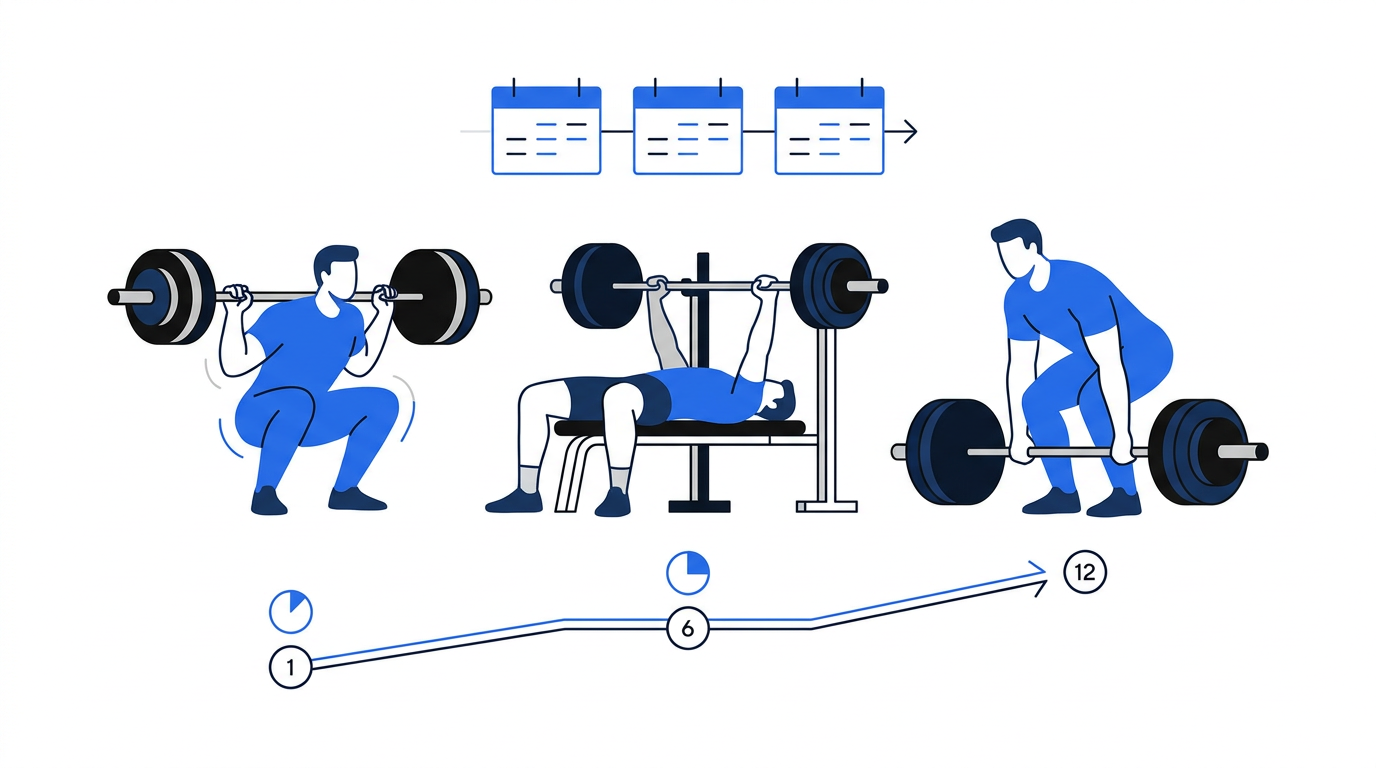
This 12-week powerlifting program for beginners uses three weekly sessions, conservative starting loads and repeatable RPE targets. You can record each session in LiftnLog so that load decisions come from completed training rather than memory.
Quick answer: how to run this beginner powerlifting program
Follow these steps in order:
- Establish conservative training maxes from smooth sets of three to five reps.
- Train three days per week, with squat twice, bench three times and deadlift once or twice.
- Use weeks 1 to 4 to practise technique and build repeatable volume at RPE 6 to 7.
- Use weeks 5 to 8 to introduce top sets followed by lighter back-off work.
- Use weeks 9 to 11 to practise heavier competition-style lifts without grinding.
- Use week 12 to test controlled singles or taper for a sanctioned meet.
- Adjust the next session from actual RPE, bar speed, technique and recovery.
The aim is not to squeeze out the largest possible increase in 12 weeks. It is to finish with stronger lifts, dependable technique and enough training data to plan the next block.
Choose starting weights for a powerlifting program for beginners
Do not base the program on a one-rep max you lifted months ago, estimated from an unrelated variation or completed with questionable depth and commands. Use a recent, technically sound set.
After several warm-up sets, perform three to five reps at approximately RPE 7. You should finish knowing that another three repetitions were probably available. Estimate your one-rep max from that set, then reduce the estimate by about 5 to 10 percent to create a conservative training max.
A beginner named Alex will serve as the worked example throughout this program. Alex has trained with barbells for six months but has never followed powerlifting programming. Recent controlled sets produce conservative training maxes of:
- Squat: 110 kg
- Bench press: 67.5 kg
- Deadlift: 145 kg
These are planning numbers, not claims about current competition maxes. Alex begins week one with approximately 72.5 kg for squat work, 45 kg for bench work and 95 kg for deadlift work. Every opening load feels manageable.
That is intentional. A weight that is slightly too light still provides useful practice. A weight that is too heavy can change the movement, distort the RPE rating and create fatigue that affects the rest of the week.
If you do not yet know how to rate effort, read how to use RPE in powerlifting before the first session. You can also use the powerlifting RPE calculator to compare completed sets with estimated strength, but treat the result as a planning estimate rather than a tested max.
Set up the three-day beginner powerlifting schedule
Leave at least one rest day between sessions. Monday, Wednesday and Friday works well, but any arrangement with similar spacing is acceptable.
On day one, perform the competition squat and competition bench press. Follow them with a row and a unilateral leg movement. This is the main squat volume session.
On day two, perform the competition deadlift and a lighter paused bench press. Romanian deadlifts and pulldowns can follow. During the first four weeks, Alex deadlifts only once per week because the main deadlift session provides enough practice and fatigue.
On day three, perform a lighter squat variation, such as a two-count pause squat, followed by the competition bench press. Add a close-grip bench press or triceps movement and trunk work. From week five, a few light technique deadlifts can be added if recovery is good.
Bench press appears three times because each session can use a different stress. One session supplies normal volume, one reinforces pauses and one gradually becomes the heavier exposure. Squatting twice provides enough technical repetition without making every session lower-body dominant.
Set each lift up according to the rules you intend to follow. The International Powerlifting Federation technical rules define standards such as squat depth, bench commands and deadlift completion. Even if your eventual federation differs, practising consistent standards prevents inflated gym results.
The complete 12-week powerlifting program for beginners
Percentages below refer to the conservative training max, not an all-time personal record. Where the percentage and RPE disagree, use the RPE target and record the difference.
| Week | Main goal | Competition lift prescription | Target effort | Load decision |
|---|---|---|---|---|
| 1 | Establish technique | 3 sets of 5 per main lift | RPE 6 | Start near 65% to 70% |
| 2 | Repeat good positions | 3 sets of 5 | RPE 6 to 6.5 | Add 1 to 2.5 kg upper body and 2.5 to 5 kg lower body if week 1 was clean |
| 3 | Build volume | 4 sets of 5 squat and bench, 3 sets of 4 deadlift | RPE 6.5 to 7 | Keep all reps technically similar |
| 4 | Deload and review | 2 to 3 sets of 4 | RPE 5 to 6 | Reduce normal working load by about 10% |
| 5 | Introduce top sets | 1 set of 5, then 3 back-off sets of 5 | Top set RPE 7 | Back-off work at 90% to 92% of the top-set load |
| 6 | Progress top sets | 1 set of 5, then 3 sets of 5 | Top set RPE 7 to 7.5 | Add load only if week 5 stayed within target |
| 7 | Increase specificity | 1 set of 4, then 3 sets of 4 | Top set RPE 7.5 | Use competition pauses and commands |
| 8 | Deload | 2 sets of 4 | RPE 5 to 6 | Reduce load by 10% to 15% and cut accessories |
| 9 | Practise heavier work | 1 single, then 3 sets of 4 | Single RPE 7, back-offs RPE 7 | Keep the single fast and technically sound |
| 10 | Build confidence | 1 single, then 3 sets of 3 | Single RPE 7.5 | Increase only if week 9 moved well |
| 11 | Final heavy exposure | 1 single, then 2 sets of 3 | Single RPE 8 | No missed lifts or slow grinders |
| 12 | Test or meet | Controlled singles or meet attempts | RPE 8 to 9 outside a meet | Reduce volume early in the week |
Weeks 1 to 4: build technique and useful volume
Keep competition movements stable during this phase. Avoid changing stance, grip or footwear after every imperfect set. Make one technical correction at a time and give it several sessions.
Alex completes week one squat work at 72.5 kg for three sets of five. The final set feels like RPE 6, so week two rises to 75 kg. Bench moves from 45 kg to 46 kg, using small plates, while deadlift rises from 95 kg to 100 kg.
In week three, the fourth set exposes a problem. Alex’s squat depth becomes inconsistent at 80 kg. Instead of adding weight, Alex repeats 80 kg during the following squat exposure and films the final warm-up plus the first work set. The program remains productive because progression includes better execution at the same load.
Week four is a planned deload. Reduce sets and weight before fatigue forces the decision. The American College of Sports Medicine notes that resistance-training progression can involve changes to load, volume, frequency and rest periods, rather than load alone, in its position stand on progression models.
Weeks 5 to 8: add top sets and back-off sets
A top set gives you a daily performance marker without requiring a max attempt. Complete one set at the prescribed reps and RPE, then reduce the load for repeatable back-off work.
Alex squats 87.5 kg for five reps at RPE 7 in week five. The back-off weight is 80 kg for three sets of five. On the next week, Alex intends to use 90 kg, but warm-ups feel unusually slow after two poor nights of sleep. The top set stays at 87.5 kg and lands at RPE 7.5.
That is successful autoregulation. The prescribed training effect was achieved without turning the session into a test.
Back-off sets should not become harder than the top set. If they do, reduce the load by another 2.5 to 5 percent or stop one set early. The detailed guide to top sets and back-off sets explains how to set the reduction when repetitions or lift demands differ.
Week eight lowers both volume and load. Keep the competition movements, but remove optional deadlift work and reduce accessory sets. A deload does not need to involve complete rest unless illness, injury or unusual life stress makes training inappropriate.
Weeks 9 to 11: practise heavier competition lifts
The single at the start of each main lift is practice, not a maximum. It should reinforce setup, commands and confidence with a heavier weight before back-off volume.
Alex opens week nine with a squat single at 92.5 kg. It feels like RPE 6 rather than the planned RPE 7, but Alex does not make a large jump. The back-off work still matters. Week ten uses 97.5 kg at RPE 7.5, followed by three triples at 85 kg.
The week 11 single reaches 100 kg at RPE 8. That result is more informative than forcing 105 kg after the prescribed work is already complete. It suggests that Alex’s original 110 kg training max was conservative and that strength has improved, but week 12 will provide the clearer test.
Use full pauses on bench press and hold completed deadlifts briefly before lowering them. Have a training partner give commands when possible. A technically invalid gym lift is poor preparation for selecting meet attempts.
Choose accessories that support the beginner powerlifting program
Accessories should address muscle development, control or tolerance that the competition lifts do not fully cover. They should not consume the recovery needed for the next squat, bench press or deadlift session.
Use two or three accessories after the main work. Practical choices include:
- Rows or pulldowns for upper-back development
- Split squats or leg presses for additional leg volume
- Romanian deadlifts or leg curls for hamstrings
- Close-grip bench presses or triceps extensions for pressing volume
- Planks, carries or controlled trunk flexion for bracing capacity
Perform most accessory sets with one to four repetitions in reserve. The distinction between RPE and repetitions in reserve is explained in RPE vs RIR for strength training.
Alex begins with two sets per accessory in weeks one and two, then uses three sets where recovery permits. Accessory volume drops during weeks four, eight and twelve. Nothing new is introduced after week eight because soreness from an unfamiliar movement could interfere with the heavier competition work.
How to adjust powerlifting weights using RPE
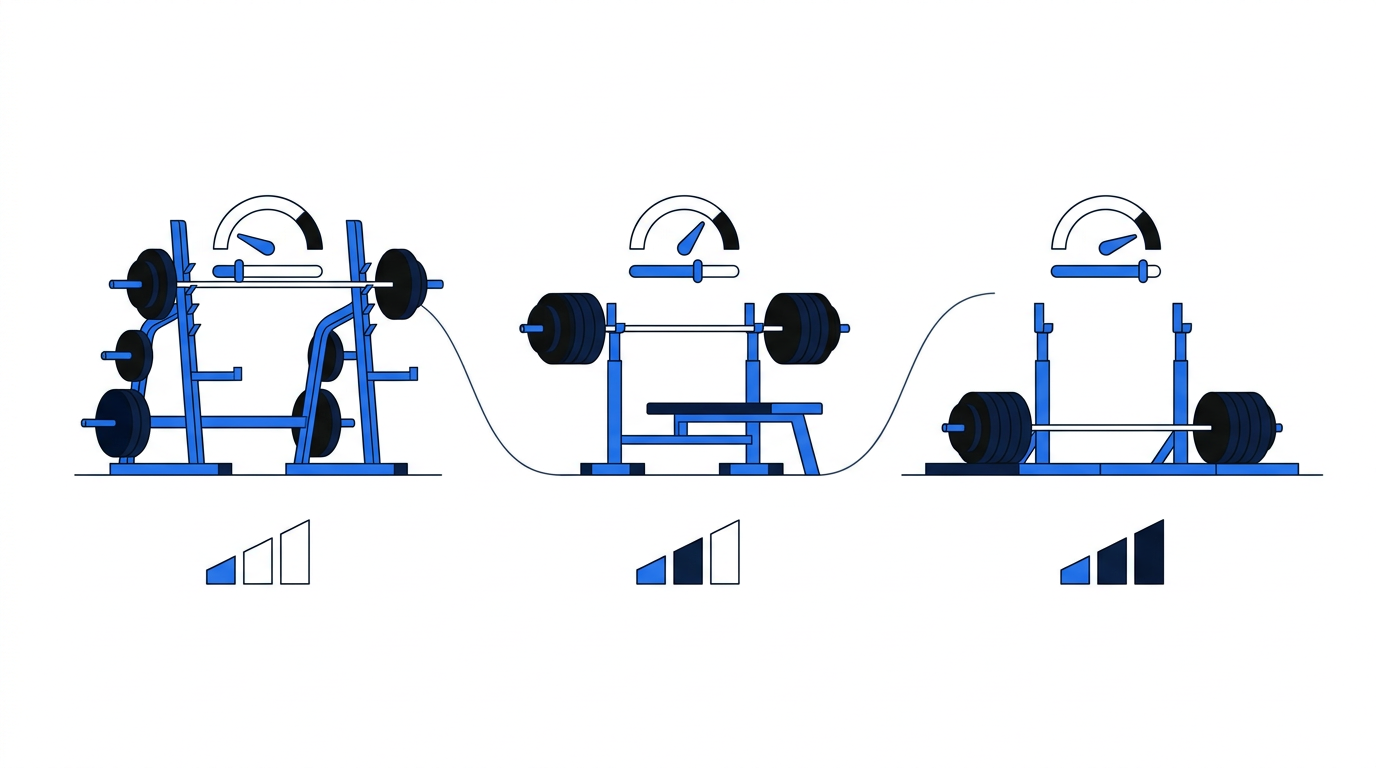
Judge adjustments from patterns, not one disappointing repetition. A single high-RPE set may reflect a poor setup, rushed rest period or incorrect plate loading. Repeated changes across warm-ups and work sets deserve more attention.
Use these rules during the program:
- If the final set is at least one full RPE below target with stable technique, make the normal increase next time.
- If the work reaches the target RPE, follow the planned progression.
- If the first work set is one RPE above target, reduce the load by 2.5 to 5 percent.
- If pain changes the movement, stop that lift and seek qualified assessment when appropriate.
- If performance declines for two or more sessions, review sleep, food, stress and total volume before changing the whole program.
RPE accuracy improves when you record the estimate before watching the video or asking a training partner. Compare the rating afterward. Lifters commonly confuse discomfort with proximity to failure, especially during sets of five.
Alex initially calls nearly every deadlift set RPE 8 because the final repetition feels tiring. Video shows consistent bar speed, and later sets confirm that two or three more reps were available. After several weeks of logging predictions and outcomes, Alex’s ratings become less reactive.
For more adjustment scenarios, use the powerlifting autoregulation guide. It covers load changes when readiness and programmed percentages disagree.
How LiftnLog supports the 12-week workflow
A spreadsheet can run this program, but it requires manual copying, calculation and comparison. A training log is most useful when the planned session and the completed session stay together.
In LiftnLog, begin by entering the three weekly sessions with their exercises, sets, repetitions and RPE targets. Record the actual load, completed reps and RPE as you train. If a top set is heavier than expected, the entry preserves both the plan and what happened rather than replacing one with the other.
Next, review previous exposures before choosing the day’s load. Alex can look back at the 87.5 kg squat set from week five, see its recorded RPE and decide whether week six calls for an increase or a repeat. The same process applies to back-off sets and accessories.
During deload weeks, keep logging. Those easier sessions show whether performance improves after fatigue falls, which helps distinguish normal accumulated fatigue from a poorly chosen starting max. By weeks nine to eleven, the history provides a direct record of single-repetition RPE, back-off performance and technical notes.
The benefit is not automatic programming for its own sake. It is having enough organised evidence to make a small, defensible adjustment instead of rewriting the block after one difficult day.
Keep training resources separate from program decisions
New lifters often collect calculators, exercise libraries, coaching material and equipment references while running their first structured block. These can help, but each resource should answer a defined question. If it cannot change a specific training decision, it probably does not need to be checked between sets.
When reviewing an external resource such as EasyX, first decide what you need from the visit. You might be researching a general training topic, comparing an exercise explanation or looking for information relevant to your location. Then verify any recommendation against your program, current ability and competition rules before applying it.
Keep the actual 12-week plan in one primary log. Copying workouts between several apps or notes creates conflicting versions, particularly after an RPE-based adjustment. Save outside references separately and write one short note when they lead to a program change.
For Alex, that means the squat load, set result and technique note remain in the training log. A useful cue found elsewhere can be added to the next session, but it does not trigger an immediate change to stance, variation, volume and loading all at once.
How to use week 12 for testing or a powerlifting meet
If you are not competing, test controlled singles across two or three sessions. Work up to approximately RPE 8 or 9, then stop. A beginner does not need to attempt a true maximum on all three lifts to measure progress.
Alex tests squat on Monday, bench press on Wednesday and deadlift on Friday. The goal is a technically valid personal best, not the largest load that can be moved under any conditions. New estimated maxes can then inform the next training block.
If week 12 ends with a meet, reduce volume while retaining some exposure to moderate or heavy weights. Do not use the non-meet testing schedule. Meet timing, weigh-ins and attempt selection require a more specific plan.
Use the powerlifting taper guide to reduce squat, bench and deadlift work at different times. Your federation may have different commands, equipment rules and weigh-in procedures, so read its current rulebook before choosing attempts.
Common mistakes in a beginner powerlifting program
Starting from an inflated max is the most common programming error. If week one already requires grinding, later progression has nowhere sensible to go. Reduce the training max and rebuild.
Another mistake is increasing weight because the calendar says so while ignoring the target effort. Percentages provide structure, but daily performance still varies. Treat them as load estimates supported by RPE, not commands that override obvious technical breakdown.
Beginners also add too many variations. Paused squats, tempo squats, block pulls and specialty-bar work can all be useful, but changing the main movement every week limits skill practice. Keep competition lifts stable throughout the block.
Finally, do not respond to every poor session with a deload. First check whether the problem came from one exercise, one loading error or one bad night. Deload when fatigue is broad enough to affect several lifts or when the planned fourth and eighth weeks arrive. A predictable reduction is easier to evaluate than emergency changes made after missed repetitions.
Powerlifting program for beginners FAQ
Can a complete beginner use this 12-week powerlifting program?
Yes, provided the lifter can perform the squat, bench press and deadlift with safe, repeatable technique. Someone who has never used a barbell may benefit from several introductory sessions with a qualified coach before assigning RPE or estimated maxes.
How many days a week should a beginner powerlifter train?
Three days is enough for most beginners to practise all three lifts and recover between sessions. Four days can work, particularly when sessions must be shorter, but it is not automatically better. Maintain the same weekly stress rather than adding a fourth day on top of the program.
Should beginners use percentages or RPE?
Use both. Percentages provide an initial range, while RPE helps account for the difference between an estimated training max and current performance. When they conflict substantially, lower the load, complete a technically sound session and review the training max afterward.
How often should beginner powerlifters deload?
This program includes deloads in weeks four and eight, with another volume reduction in week twelve. Some beginners may not need a full deload every four weeks, but planned reductions make the first block easier to manage and review. Later programs can extend or shorten the interval based on recorded fatigue.
What if I miss a workout during the 12 weeks?
Do not combine two full sessions to catch up. If the missed session is isolated, continue with the next scheduled day or move the week back by one session. After a longer interruption, repeat the previous successful week with slightly lower opening loads.
Can this program prepare me for my first powerlifting meet?
It can provide the base, especially if weeks nine to eleven use competition standards. A meet also requires federation-specific commands, approved equipment, attempt selection and a suitable taper. Align week twelve with the meet date rather than testing in the gym first.
What should I do after week 12?
Review which lifts progressed, where technique failed and whether the RPE targets matched actual performance. Update conservative training maxes from valid week 12 lifts, keep useful accessories and begin another block with slightly more individualised volume. Continue logging enough detail to explain each adjustment.