Every block starts one of three ways.
A block is a multi-week program. You choose one of three ways to build it. The same engine runs it either way.
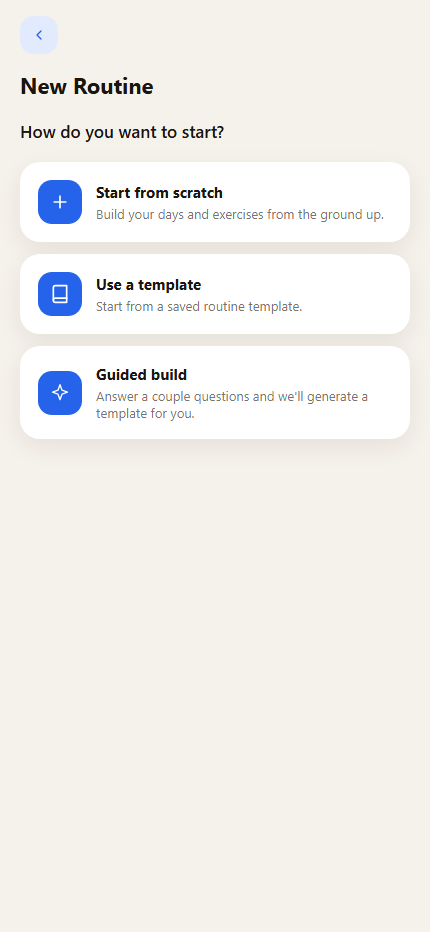
You pick your days per week. Then you build every exercise yourself from a library of more than 1,300 exercises. The library is searchable, grouped by muscle, and reorderable within the day.
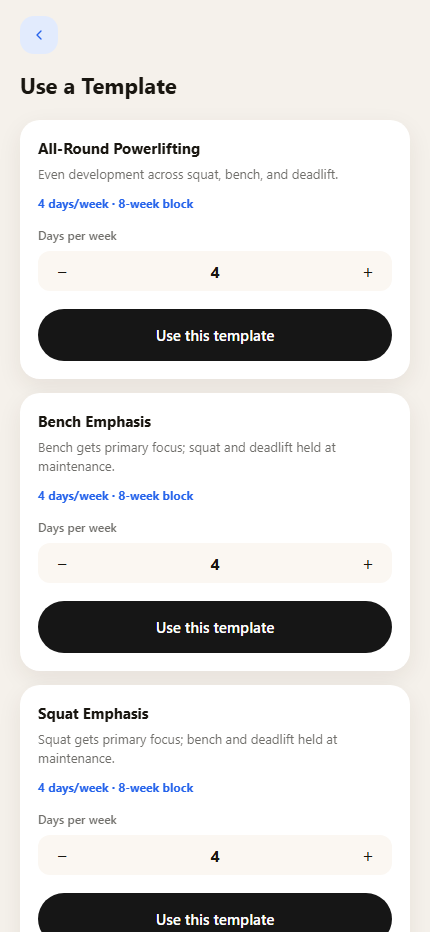
Four hand-built powerlifting templates: all-round, squat emphasis, bench emphasis, and deadlift emphasis. You can adjust each one from 2 to 6 days a week.
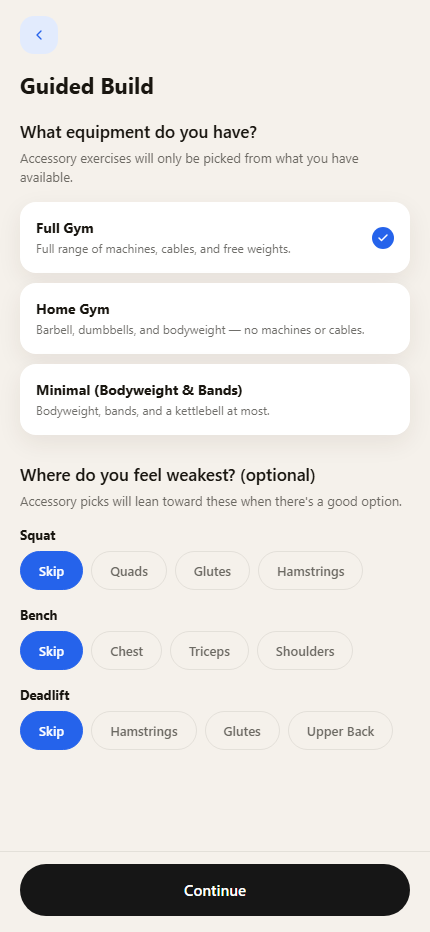
You answer a few questions: your main goal, your equipment, and your weak points per lift. LiftNlog then builds the full plan. The plan has real accessories, rep ranges, progression methods, and swap-in alternates. It is tapered toward your goal.
The 30 seconds of input that makes the adaptation real.
There are three kinds of input. Each one takes a few taps. The engine has nothing to read without them.
You rate sleep, fatigue, hydration, and motivation. You also log your weekly bodyweight. It takes a few taps. The check-in then gives you a recommendation for the day: train as planned, train with a change, or rest.
Every working set carries a target RPE that LiftNlog prescribed. You log the RPE you hit against it. That gap is the whole signal.
You rate technique after each exercise. It has its own "technique broke down" flag. Technique is kept out of RPE on purpose. A hard set and a set with broken technique are different signals.
When the week does not go to plan, you have options. You can skip a session or one exercise. You can swap an exercise for an alternate. You can add an extra exercise. You can leave a note on the session.
Logged RPE moves your e1RM. Your e1RM writes the next session.
LiftNlog compares the RPE you logged against the target RPE for that working set. It then moves your estimated one-rep max (e1RM) for the lift. The top set, the back-off weights, and the accessory volume all recalculate from the new e1RM. Your weekly weigh-in adjusts how fast the weight climbs back.
Weights increase. The next top set goes heavier. The back-off weights recalculate from it. The accessory volume rises with it.
Weights hold. The prescription was right for the day, so the block carries on as written.
Weights decrease. You stop straining against a max you tested weeks ago. You train from today's number instead.
It runs in both directions, every session. This includes meet prep. The engine handles the taper, so you do not improvise it in the last three weeks.
Once you can see the trend line move, "adapts" is not just a claim.
LiftNlog shows a live e1RM trend for squat, bench, and deadlift. It is built from what you logged, not from a max you tested months ago.
The trend updates every time you close a set. If the engine raised your squat e1RM for three sessions in a row, you can trace back which sets did it.
When a block finishes, LiftNlog writes a summary of what happened and what most likely limited progress. You can add a short reflection to keep it on the record.
Every set you log: weight, reps, RPE, technique rating, and notes. Nothing is summarized away.
Who it is for, and who it is not.
Join the LiftNlog waitlist
Waitlist members get early access and early pricing. We will email you as soon as we launch.
Pricing is not public yet. See the Pricing page for what waitlist members get.