
How Much Weight Should You Drop After a Top Set?
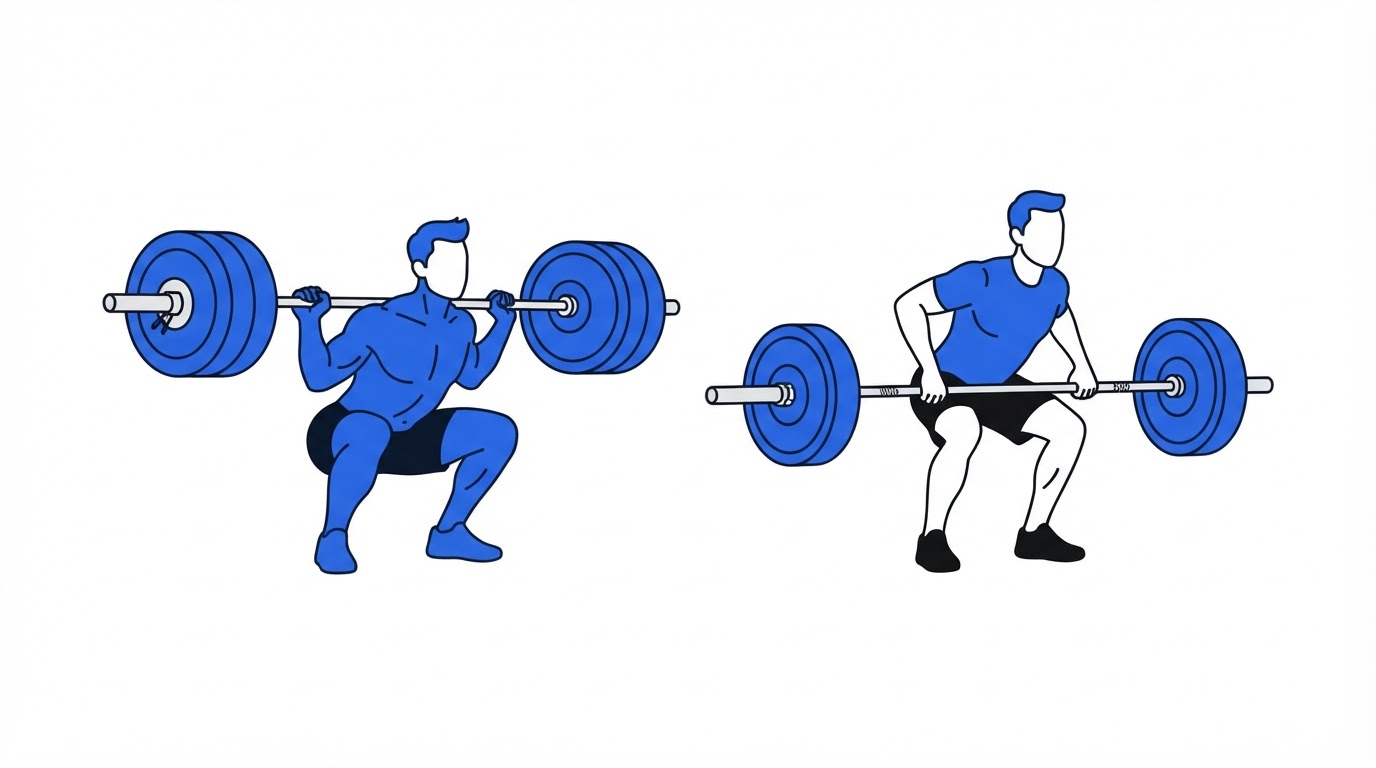
You finish a hard squat top set, strip plates, and face the useful decision: how much weight should come off before the volume work starts? Drop too little and the back-off sets turn into repeat grinders. Drop too much and they stop supplying enough specific strength practice.
LiftnLog helps powerlifters record the top set, back-off work, reps, and RPE in one training log, which makes this adjustment easier to repeat from week to week. For most work in the strength-building portion of a block, a 5% to 10% reduction from the top set is a practical starting range.
Quick answer: how to choose back-off weight after a top set
- Set the top set load, reps, and target RPE first.
- Drop 3% to 6% when back-off sets use similar reps, or 6% to 12% when they use several more reps.
- Use the smaller drop for an easy, fast top set and the larger drop after a slow or higher-RPE top set.
- Round to a load you can put on the bar, then judge the first back-off set by completed reps and RPE.
- Adjust later sets by 2.5% to 5% when the first set lands well outside the intended effort.
The percentage gets the first set close. The lifter’s performance determines whether it stays there.
Start with the top set and back-off sets prescription
A useful top set gives you a high-quality exposure at a demanding weight. Back-off sets add productive volume with cleaner repetitions and less accumulated fatigue. The load reduction depends on what the session asks for after that top set.
For example, consider Maya’s squat day during a general strength block:
- Top set: 365 lb for 3 reps at RPE 8
- Back-off prescription: 3 sets of 5 reps at RPE 7 to 8
- Planned reduction: 8%
- First back-off load: 335 lb, rounded from 336 lb
Maya uses more reps in the back-off work than in the top set. That added rep demand calls for a meaningful reduction. At 335 lb, she completes 5, 5, and 5 reps at RPE 7, 7.5, and 8. The choice worked, so the same relationship between top set and back-off load is worth trying again when the next top set moves similarly.
For a fuller explanation of exercise order, set counts, and programming options, read this guide to programming top sets and back-off sets for powerlifting. This article focuses on the narrower loading decision after the top set.
Choose a back-off percentage from the rep gap
The gap between top-set reps and back-off reps is the first thing to calculate. More back-off reps require a larger reduction because the set contains more total work at a similar movement pattern.
| Top-set and back-off prescription | Starting reduction from top-set load | Example from a 365 lb top set | Typical use |
|---|---|---|---|
| 1 to 3 reps, then 1 to 3 reps | 3% to 6% | 345 to 355 lb | Heavy strength practice and late peaking |
| 3 reps, then 4 to 5 reps | 6% to 10% | 330 to 345 lb | General strength blocks |
| 4 to 5 reps, then 6 to 8 reps | 8% to 12% | 320 to 335 lb | Volume-focused off-season work |
| 1 single, then 3 to 5 reps | 8% to 15% | 310 to 335 lb | Specificity practice followed by volume |
These ranges are starting points rather than fixed rules. A lifter with strong repeatability may work near the smaller reduction. A lifter whose performance falls sharply after a hard top effort may need the larger end of the range.
Bench press often tolerates smaller load changes than deadlift because bench sessions commonly include more weekly practice and less whole-body fatigue per set. Deadlift back-offs frequently need a larger reduction, especially after a hard triple or single. Squat often sits between them, though individual leverages and work capacity can move the result either way.
Use your actual history. Export or review your last several similar sessions and compare the top-set RPE with the final back-off RPE. Patterns from your own log beat a generic percentage chart.
Use RPE to decide whether the drop should be smaller or larger
RPE describes how many repetitions a lifter could likely still complete with sound technique. A top set at RPE 7 leaves roughly three reps in reserve, while RPE 9 leaves roughly one. That difference changes the back-off decision even when the barbell weight matches.
Maya’s 365 lb for 3 at RPE 8 supports 335 lb for 3 sets of 5. Suppose the same 365 lb top set reaches RPE 9.5 after poor sleep and slow ascent speed. Keep the planned rep target, but begin the back-off work closer to a 10% to 12% reduction, or 320 to 330 lb. The session still delivers squat volume without turning every set into a maximal effort.
A top set that lands below target has room for a smaller reduction. If Maya planned RPE 8 and gets 365 lb for 3 at RPE 7, 345 lb may be appropriate for the first set of 5. Stop there and assess the set. Adding weight across every back-off set creates extra fatigue with limited benefit when the prescription already targets a useful effort range.
Use the same RPE scale consistently. If you are still building that skill, learn how to choose powerlifting loads with RPE before making large day-to-day changes. For a numerical cross-check, LiftnLog’s powerlifting RPE calculator can estimate the relationship between reps, effort, and likely one-rep-max strength.
The ACSM progression models for resistance training support adjusting training variables as strength and training status change. RPE gives a lifter a practical way to make that adjustment within a planned session.
Adjust top set and back-off sets for each training phase
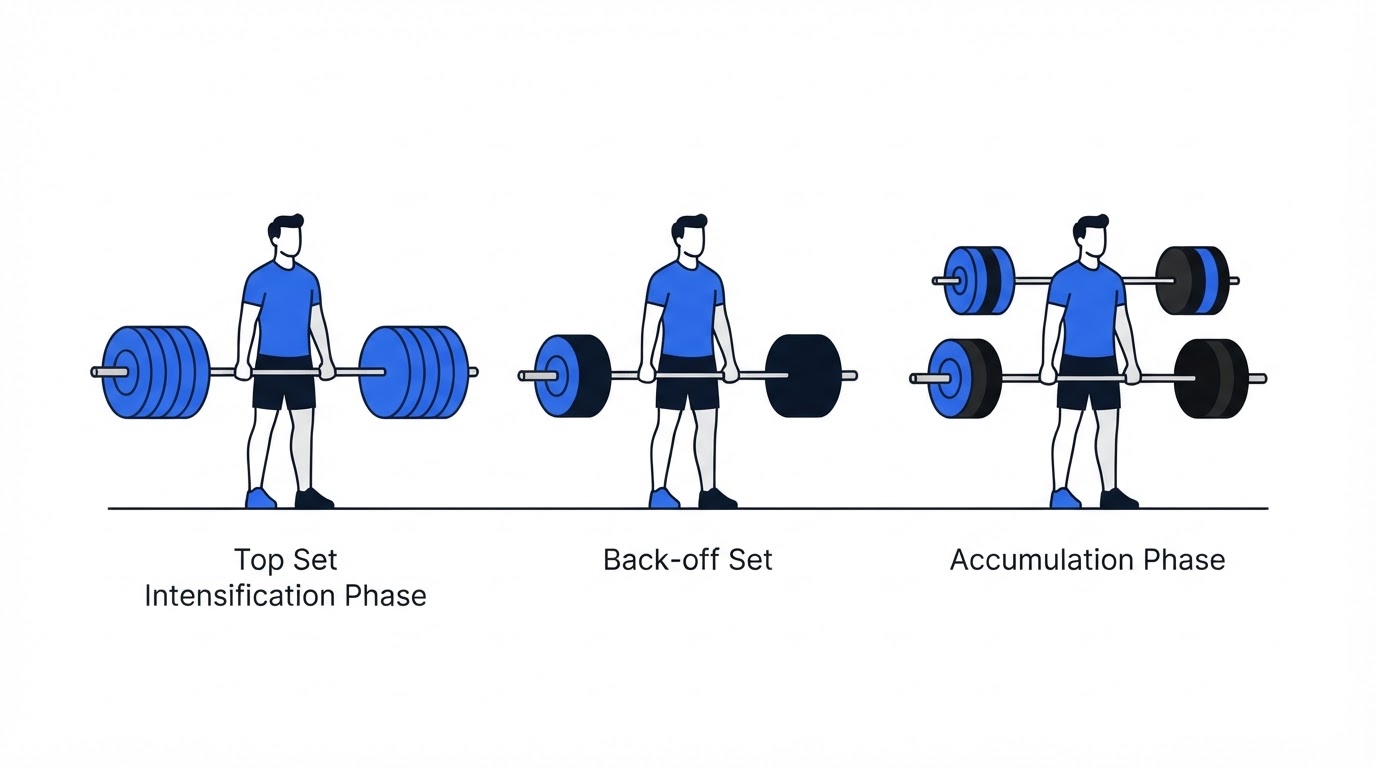
The same top set can lead to very different back-off loads across a training cycle. Match the reduction to the purpose of the phase.
Off-season and volume blocks
Use larger rep gaps and reductions around 8% to 15%. A top triple followed by sets of six creates substantial skill practice and muscle-building volume, provided technique remains stable. Back-off RPE commonly sits around 6 to 8.
For Maya, 365 lb for 3 at RPE 8 could lead to 315 to 325 lb for 3 sets of 6. The lower load protects rep quality while the higher set volume builds the session’s workload.
Strength blocks
Use reductions around 5% to 10% for back-off sets of three to five reps. This is where Maya’s 365 lb triple and 335 lb sets of five fit well. The session stays close enough to competition strength demands while providing repeatable work.
Meet prep and peaking
Use smaller rep gaps, fewer back-off sets, and often a 3% to 8% reduction. A lifter may perform a single at RPE 7.5 to 8, then complete two or three doubles with a controlled load. Fatigue management becomes increasingly valuable as competition approaches.
A taper reduces volume while keeping enough intensity to retain familiarity with heavy attempts. Follow a structured powerlifting taper before a meet rather than carrying normal back-off volume into the final weeks.
Judge the first back-off set before committing to the rest
The first back-off set is a live test of the load selection. Watch for technique, bar speed, completed reps, and RPE. Record each one while the details are fresh.
Maya’s planned 335 lb set of five gives three possible outcomes. Five smooth reps at RPE 6 suggests 5 to 10 lb more for the next set if the program calls for RPE 7 to 8. Five reps at RPE 7 to 8 keeps the load where it is. A grinding fifth rep at RPE 9.5 calls for a 10 to 20 lb reduction before the next set.
Make the adjustment once, then keep the remaining work stable where possible. Constantly chasing tiny changes makes it hard to see whether the overall progression is working.
Technique is part of the test. On squat, watch depth and bracing. On bench, keep the pause, touch point, and leg drive consistent. On deadlift, maintain the same setup and lockout standard. A completed rep only counts as useful data when it resembles the intended competition movement.
Track the decision inside LiftnLog
A spreadsheet can handle this process, though the work adds up across three competition lifts and several training days. LiftnLog is built around the information that drives the next loading decision.
First, enter the programmed top set with its target reps and RPE. After the set, log the actual load, reps, and RPE. Next, enter the back-off load you calculated from the rep gap and training phase. Record the first back-off set before changing later sets. At the next exposure, review the previous top set and final back-off set together, then select a starting load from that relationship.
This creates a useful history for each lift. A recurring pattern of missed back-off reps after RPE 8 top sets points toward a larger reduction, less volume, or a recovery issue. A recurring pattern of easy back-off work supports gradual progression. When fatigue continues across sessions, consult the signs and adjustments in this guide on when powerlifters should deload before adding more load.
Common mistakes when choosing a back-off weight
The most frequent error is applying the same percentage to every lift and every rep scheme. A 5% drop from a heavy single may suit doubles, while it can be far too aggressive for sets of six.
Another mistake is treating the top-set load as an obligation for the back-off work. A tough top set provides information. Use that information to choose a load that matches the remaining prescription.
Avoid reducing the load only because the top set felt psychologically hard. RPE, completed reps, bar speed, and technique offer better evidence than nerves before a demanding set. Also avoid loading changes so large that the back-off work becomes warm-up weight. The final sets should still require focus and sound execution.
Research on resistance-training progression also emphasizes planned manipulation of volume and intensity over time, as outlined in the ACSM guidance on resistance exercise. Record enough session detail to make those changes from evidence.
FAQ
How much should I drop after a top set of 3?
Start with a 6% to 10% reduction when your back-off sets are sets of four to five. Use the lower end after an RPE 7 to 8 top triple and the upper end after RPE 8.5 to 9 work. A 365 lb top triple commonly leads to roughly 330 to 345 lb for sets of five.
Should back-off sets use a percentage or RPE?
Use both. Percentage provides a fast first estimate, while RPE confirms whether that estimate fits your readiness and performance that day. Record the actual result so your next estimate improves.
What if my top set is below the target RPE?
Use a smaller reduction, add a small amount to the back-off load, or keep the original plan and perform the work with extra speed. Choose the option that keeps the back-off sets within their programmed rep and effort range.
Can I use the same back-off weight for squat, bench, and deadlift?
You can, provided the performance data supports it. Many lifters need a larger deadlift reduction and can handle more bench volume. Build lift-specific records over several weeks before settling on a standard approach.
When should I reduce back-off volume instead of weight?
Reduce set count when performance remains poor despite a sensible load reduction, when fatigue carries into later sessions, or during a planned taper. Keep the most valuable repetitions high quality, then remove the volume that recovery cannot support.
Start with the percentage range that fits your rep gap, validate it on the first back-off set, and save the result. Over time, your own top set and back-off sets data becomes the clearest guide to the load reduction that works for you.